Israel Election Leaves Netanyahu Short of Power as Arab Parties Gain Historic Influence

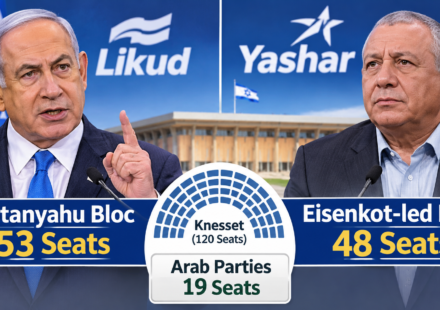
Israel’s election has produced an uncertain parliamentary landscape, with Prime Minister Benjamin Netanyahu’s political bloc leading the partial seat count but falling short of the numbers required to govern independently. With more than 85% of the overall vote represented in the count, Netanyahu’s bloc stood at 53 seats, while the opposition grouping led by former military chief Gadi Eisenkot held 48. Arab parties had secured 19 seats, giving them a potentially important role in negotiations over the next government.
The figures released during the count reflected approximately 85.6% of all votes cast, although around 93% of ordinary ballots had been processed. The remaining votes, including hundreds of thousands cast through double envelopes, were still awaiting counting or verification. The distribution was therefore not yet final, and the political consequences remained uncertain.
Neither Main Bloc Has Reached a Majority
Israel’s parliament, the Knesset, has 120 seats. A government normally needs the support of at least 61 lawmakers to command a majority.
At the reported stage of the count, Netanyahu’s bloc was eight seats short of that threshold. Eisenkot’s grouping was further away on its own, meaning that neither side could rely solely on its current seat total to form a majority government.
The arithmetic leaves political leaders facing difficult choices. Netanyahu could seek support from parties outside his existing alliance, while opposition leaders would need to bring together groups with different political priorities if they hope to replace his government.
Although the partial results put Netanyahu’s bloc ahead of Eisenkot’s grouping, a lead in seats does not automatically translate into the ability to form a government. Coalition agreements, parliamentary support and the positions of smaller parties will determine what happens next.
Arab Parties Record a Historic Parliamentary Presence
The 19 seats attributed to Arab parties represented a significant result and could make their political decisions particularly important during coalition negotiations.
Their combined representation gives them the potential to influence whether an alternative parliamentary majority can be assembled. However, their seat total does not guarantee that they will enter a governing coalition or that the other opposition parties will agree to cooperate with them.
Political differences remain a major obstacle. Some opposition figures have called for cooperation with Arab parties to prevent Netanyahu from returning to power, while other politicians have expressed reservations about such an arrangement.
The central question is whether parties that campaigned against Netanyahu can agree on a shared programme and a practical plan for governing. Their ability to do so will matter as much as the seat totals themselves.
Eisenkot Faces a Coalition-Building Challenge
Gadi Eisenkot, leader of the Yashar party and a former military chief, has emerged as the central figure in the opposition grouping.
His path to power depends on more than his own party’s performance. He would need to secure sufficient support from other political groups and overcome disagreements that could prevent them from working together.
Some opposition leaders have argued that cooperation with Arab parties could provide the numbers needed to form a government. Such a partnership, however, would require negotiations over policy priorities, political representation and the terms on which parliamentary support would be provided.
Even if an alternative majority appears possible on paper, translating it into a stable government could prove difficult. Parties may disagree over security policy, relations with Palestinians, religious issues, public spending and other matters that have divided Israeli politics.
Netanyahu Calls for a Right-Wing Government
Netanyahu has continued to argue for a right-wing government and has rejected the idea of relying on Arab parties to secure his political future.
His position reflects the difficulties facing both major camps. While his bloc remained ahead in the reported count, it had not reached the 61-seat threshold. He would therefore need to secure additional parliamentary backing if the final figures remain similar.
Netanyahu’s supporters may seek to maintain the existing political alliance, but the outcome will depend on the final distribution of seats and the willingness of potential partners to join or support a government.
The election result also leaves open the possibility of further negotiations, political compromises or a prolonged period of uncertainty if neither side can assemble a workable majority.
Why the Remaining Votes Matter
The reported figures were based largely on ordinary ballots, with hundreds of thousands of double-envelope votes still to be counted. Such ballots can include votes from groups whose voting procedures differ from those used at regular polling stations, including military personnel.
These outstanding votes could alter party totals and affect the final allocation of seats. Although the latest reported count suggested that immediate updates were unlikely later on Wednesday, the result was still provisional.
The Central Elections Committee must complete the counting and verification process before the final outcome is established. Until then, political claims about who has won or lost the election should be treated cautiously.
The difference between a narrow lead and a parliamentary majority is particularly important in Israel, where government formation depends on agreements among multiple parties rather than simply on which bloc finishes first.
What the Result Means for Israel
The election has left Israel facing another difficult period of coalition bargaining. The next government’s composition will influence domestic policy and the country’s approach to security, regional diplomacy and relations with international partners.
For Netanyahu, the immediate challenge is to find enough parliamentary support to continue leading the government. For Eisenkot and the opposition, the task is to demonstrate that their parties can cooperate despite ideological differences.
Arab parties may have increased leverage in the negotiations, but their influence will depend on whether other political groups are willing to work with them and what agreements can be reached.
If the major blocs remain unable to secure a majority, negotiations could become prolonged and raise the possibility of further political instability. The final ballot count will help clarify the available options, but it may not resolve the underlying disagreements.
The key takeaway: Netanyahu’s bloc was leading the partial count, but it remained short of a majority. Eisenkot’s opposition grouping also lacked sufficient seats on its own, while Arab parties held a potentially influential position. The next stage of Israeli politics will depend on the final results and the coalition agreements that follow.
Netanyahu Faces Signs of Waning Support in Likud Stronghold Ahead of Israel Election
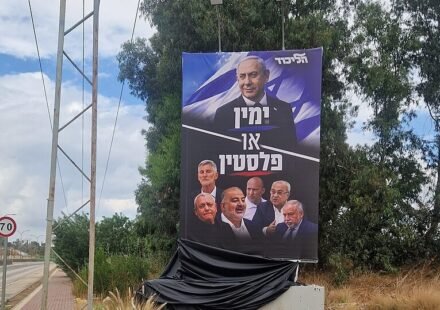
Israeli Prime Minister Benjamin Netanyahu is facing growing frustration among some voters in a traditional stronghold of his Likud party, as residents of the northern border city of Kiryat Shmona question the government’s handling of security threats and the aftermath of the conflict with Hezbollah. The developments come just days before Israel’s October 27 national election.
Kiryat Shmona, located near Israel’s border with Lebanon, has historically been an important centre of support for the political right. However, repeated cross-border attacks, a prolonged evacuation and the slow recovery of everyday life have left some residents dissatisfied with the government’s response.
The shift in sentiment does not mean Netanyahu has lost the support of the entire city. Rather, interviews with residents indicate that some long-standing Likud supporters are reconsidering their political choices, creating an additional challenge for the prime minister as he seeks to retain power.
Security Concerns Shape Voters’ Views
For residents of Kiryat Shmona, security is not an abstract campaign issue. The city has endured repeated threats from Hezbollah, the Iran-backed armed group operating in Lebanon, since the escalation of hostilities in 2023.
The fighting forced many residents to leave their homes for extended periods. Although efforts have been made to restore normal life, the return of residents and businesses has been uneven. Reports indicate that only around half of the city’s pre-war population had returned, highlighting the scale of the disruption.
The consequences extend beyond physical damage. Displacement has affected local businesses, employment, education and community life. Residents who expected a stronger sense of security after months of conflict are now questioning whether the government has delivered on its promises.
Some voters interviewed in the city have expressed disappointment with Netanyahu’s handling of the northern front. Their concerns include whether Hezbollah has been sufficiently weakened and whether the government can provide lasting protection for communities close to the Lebanese border.
Long-Time Likud Supporters Reconsider Their Choices
The emerging dissatisfaction is particularly significant because Kiryat Shmona has traditionally backed Likud, Netanyahu’s right-wing political party. Support for Likud in previous elections has been strong, making the city an important location for understanding the mood among conservative voters.
Some residents who previously supported Netanyahu are now considering alternative political options. These include opposition figures such as Gadi Eisenkot, a former Israel Defense Forces chief of staff whose campaign has sought to attract voters concerned about the government’s leadership and security record.
Other voters may remain on the right but prefer parties that take a harder line on national security. This suggests that frustration with Netanyahu does not necessarily translate into support for the political left or a single opposition party.
The distinction matters in Israel’s electoral system, where voters choose parties for the 120-seat Knesset, or parliament, and governments are formed through coalition negotiations. Changes in support among traditionally reliable voters can affect the distribution of seats and the ability of political blocs to assemble a governing majority.
The Wider Political Challenge for Netanyahu
Netanyahu has built much of his political reputation around security and his claim that he can protect Israel in a hostile regional environment. However, the Hamas-led attack of October 7, 2023, and the conflicts that followed have placed his government’s security record under sustained scrutiny.
The prime minister has highlighted military operations against Israel’s adversaries as evidence of his government’s approach. Critics, however, continue to question how the October 7 attack occurred and whether the government has adequately addressed the consequences of the ensuing conflicts.
The situation in northern Israel adds another dimension to that debate. For residents who experienced evacuation and prolonged insecurity, national security is measured not only by military operations but also by whether they can safely return home and rebuild their lives.
Netanyahu’s political difficulties are also unfolding amid a closely contested national campaign. Recent polling reported by Israeli media has shown the main political blocs struggling to secure the 61 seats needed for a majority in the Knesset. Polls are snapshots of voter opinion, however, and do not determine the final result.
Local Frustration Does Not Guarantee an Election Shift
Despite signs of discontent, it would be premature to conclude that Netanyahu has lost his political base in Kiryat Shmona or that dissatisfied residents will all vote for the opposition. Long-standing political loyalties, ideological preferences and concerns about alternative leaders may still influence voting decisions.
Some voters may also judge the government according to its wider security policies rather than the situation in their own city. Others could remain loyal to Likud while demanding changes in how the northern region is protected and rebuilt.
The election will reveal whether these frustrations translate into a measurable change in support. For opposition parties, the challenge is to persuade dissatisfied voters that alternative leadership can address security concerns and the region’s economic recovery.
Northern Israel Becomes a Test of Government Accountability
Kiryat Shmona illustrates the difficulties governments face when military action does not quickly restore normal life in communities affected by conflict. Security guarantees must ultimately be assessed against the everyday experiences of residents who have lost homes, businesses and a sense of stability.
For Netanyahu, the concerns emerging from a traditional Likud stronghold represent a test of whether his long-established political appeal can withstand dissatisfaction over security and recovery. For voters, the election offers an opportunity to evaluate the government’s record alongside the proposals of competing parties.
As Israelis prepare to vote on October 27, the mood in northern border communities provides one indication of the issues shaping the campaign. Whether that frustration leads to a significant electoral change remains uncertain, but the experiences of residents have placed security, accountability and reconstruction firmly in the political debate.