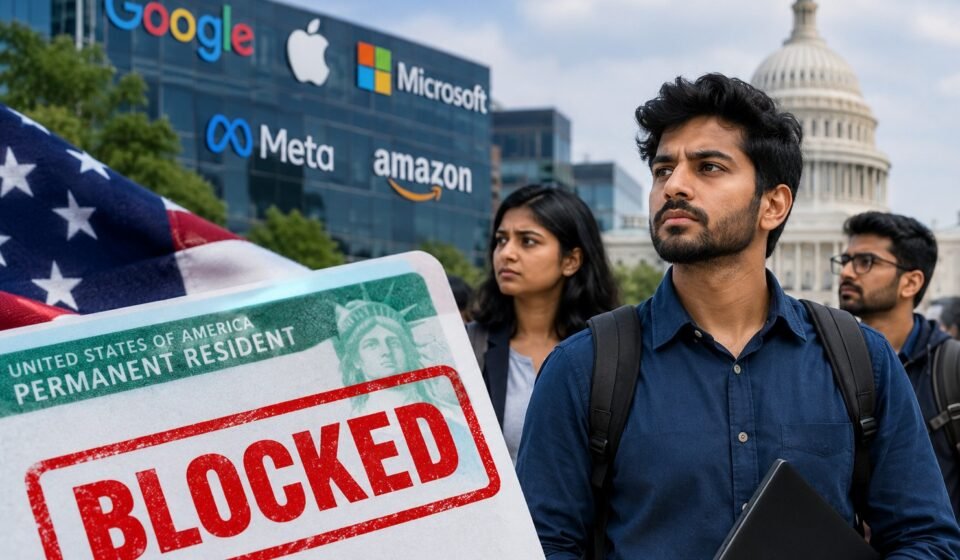

The United States has suspended Microsoft, Adobe and several major technology and IT services companies from a federal programme used by employers to sponsor skilled foreign workers for permanent residency, opening a new front in the Trump administration’s crackdown on employment-based immigration.
The companies named in the action include Microsoft, Adobe, Cognizant, Infosys, Tata, Wipro, HCL Technologies and Capgemini, according to US officials and Reuters reporting. The Department of Labor’s action targets participation in the Permanent Labor Certification (PERM) programme, a key step for many employer-sponsored employment-based green card applications.
What the US government has done
US Vice President JD Vance and Labor Secretary Keith Sonderling announced the suspensions on Thursday, October 8.
Sonderling said the companies would be suspended from the PERM programme amid allegations of misuse and fraud involving employment-based immigration programmes. The administration said the policy is intended to ensure that American workers receive greater consideration for available jobs.
Vance specifically criticized Microsoft’s use of foreign-worker programmes and argued that major US companies should increase hiring of American workers. The administration has also launched investigations into alleged misuse of international student visa programmes at several US universities.
This is not an H-1B suspension
Despite being described as part of a wider H-1B crackdown, Thursday’s action does not itself cancel H-1B visas held by employees of the affected companies.
Instead, the immediate target is the PERM labour certification system. Employers generally use PERM as an important step when seeking employment-based permanent residency for foreign workers.
That distinction is significant for Indian technology professionals. A worker may legally hold an H-1B visa but still depend on an employer-sponsored green card process to remain in the United States permanently. Suspension from PERM could therefore make the long-term immigration process more difficult or uncertain for affected employees.
Why Indian IT companies are affected
Indian technology companies have historically relied heavily on US immigration programmes to deploy skilled professionals in the American market.
Infosys, Cognizant, Tata, Wipro and HCL are among the large IT services companies affected by the latest decision. Their US operations employ large numbers of technology professionals, including workers who use employment-based immigration pathways.
The development comes after other US policy changes have already increased pressure on companies that depend on foreign technology workers. The Trump administration has also maintained restrictions affecting H-1B workers entering the United States, including a $100,000 payment requirement for certain new H-1B petitions involving workers outside the country.
What it could mean for employees
The immediate impact will vary from worker to worker depending on the stage of their immigration case.
Employees with existing H-1B status are not automatically losing their visas because of the PERM suspension. However, workers who are relying on their employer to begin or continue the labour-certification stage of a green card application could face delays or uncertainty.
For Indian professionals, the issue is particularly sensitive because employment-based immigration to the US can involve lengthy waits, especially for applicants from countries with high demand for employment-based green cards.
The latest decision could also encourage affected companies to reconsider how they recruit and deploy workers in the United States, potentially increasing reliance on local hiring and overseas delivery centres.
Part of a broader immigration push
The PERM suspensions follow a series of actions by the Trump administration aimed at tightening the US employment-based immigration system.
In September, the White House extended restrictions on certain H-1B workers and maintained a $100,000 payment requirement for specified new petitions involving workers outside the United States. The administration has argued that the H-1B programme has been abused by some employers and that foreign labour can put pressure on American wages and employment opportunities.
The latest PERM action therefore adds another layer to the immigration challenge facing global technology companies and their foreign employees.
For Indian IT workers in the United States, the key question now is how long the suspensions will remain in place and whether the affected companies will be allowed to resume green card sponsorship after the federal investigations are completed.