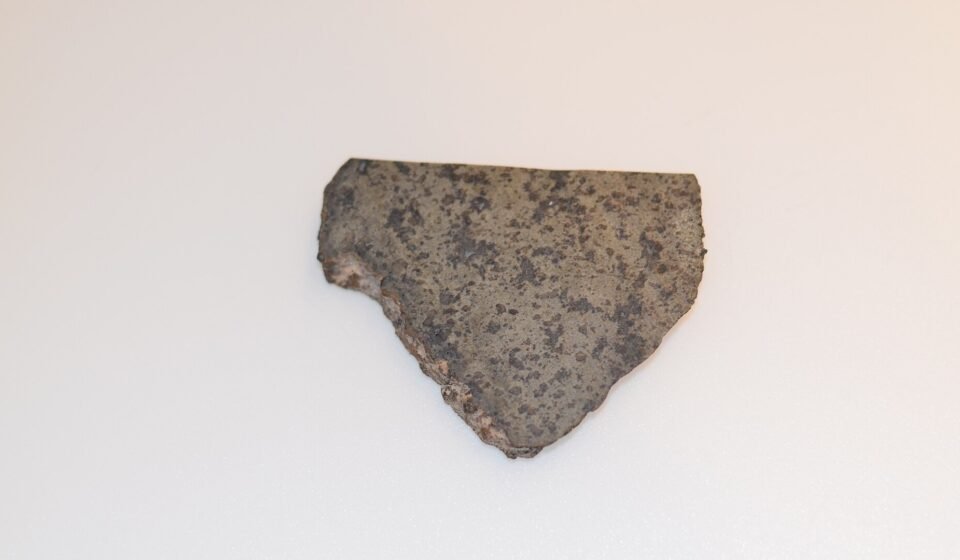

A small, rose-coloured rock discovered in the Sahara Desert has given scientists an extraordinary opportunity to investigate the early history of Mars. Named Teghaza 001, the nearly 800-gram meteorite has been dated to more than 4.1 billion years ago, placing it among the oldest known Martian rocks ever recovered on Earth.
The discovery is important not simply because of the meteorite’s age, but also because its minerals preserve evidence of ancient volcanic activity and interactions between rock and water. These clues are helping researchers reconstruct what Mars was like during a period when its surface and interior were very different from the cold, largely dry environment seen today.
The findings were detailed in a scientific study published in the journal Science on October 29, 2026. Researchers say the meteorite offers a rare opportunity to examine material linked to the early formation of the Red Planet’s crust.
A Desert Discovery With a Planetary Connection
Teghaza 001 was discovered in 2022 in the Sahara region of Mali, near the salt plain after which it was named. At the time, its extraordinary geological significance was not immediately apparent.
Scientists eventually identified the rock as Martian by examining its chemical composition and oxygen isotopes. These measurements act like geological fingerprints, helping researchers distinguish material originating on Mars from rocks formed on Earth or other celestial bodies.
Meteorites from Mars reach Earth after powerful impacts eject fragments of the planet’s surface into space. Some of these fragments travel through space before entering Earth’s atmosphere and landing on its surface.
Although hundreds of Martian meteorites have been identified, very few preserve such an ancient record of the planet’s formation. Teghaza 001 is particularly valuable because its mineral composition provides information about a part of Martian history that remains poorly represented in the samples available to scientists.
How Researchers Determined the Rock’s Age
Determining the age of a meteorite requires more than examining its appearance. Scientists study the minerals inside it and measure radioactive isotopes that change at predictable rates over time.
In Teghaza 001, researchers examined zircon crystals and used uranium-lead dating to establish its ancient history. They also applied a rubidium-strontium dating technique to individual mineral grains, helping confirm the age estimate while preserving valuable material for future research.
The results indicated that the rock had been altered by water on Mars around 4.1 billion years ago. The material itself may have formed even earlier.
That distinction matters. The date associated with water-related alteration tells researchers when important geological changes occurred, while the rock’s original formation may extend further back into the planet’s early development.
The study therefore provides more than a single age measurement. It offers a way to investigate the sequence of events that shaped Mars when its crust and interior were still evolving.
Evidence of Volcanoes and Ancient Water
One of the most interesting features of Teghaza 001 is its mixture of igneous minerals. Igneous rocks form when molten material cools and solidifies, making them valuable records of volcanic and internal geological processes.
The meteorite’s mineral structure suggests that its original material formed from cooling magma before later changes affected it. Researchers found evidence that water interacted with the rock, providing clues about the movement of fluids through early Martian crust.
Today, Mars is known for its dusty plains, ancient river channels, polar ice and signs of water-related geological activity. However, scientists are still working to understand how much liquid water existed on the planet in its earliest periods and how long favourable conditions may have lasted.
Teghaza 001 adds another piece to this puzzle. Its composition supports the idea that early Mars experienced a more dynamic geological and water cycle than the planet’s present-day appearance might suggest.
The meteorite is also chemically distinct from many other Martian samples. Its mineral characteristics resemble materials observed in parts of Mars’ ancient southern highlands, although scientists have not established its exact original location. Researchers have identified 13 possible locations whose characteristics match the rock’s composition.
Could Ancient Mars Have Supported Life?
The presence of evidence for water naturally raises questions about whether Mars might once have supported life.
On Earth, liquid water is essential for all known forms of life. Scientists therefore consider ancient Martian environments that contained water among the most promising places to investigate when assessing whether the planet may once have offered suitable conditions for biological activity.
Teghaza 001 is relevant to this question because it records interactions between water and rock during Mars’ distant past. Studying such interactions can help researchers understand the chemical environments that existed beneath or near the planet’s ancient surface.
However, the discovery does not demonstrate that life ever existed on Mars. Evidence of water is not the same as evidence of living organisms, and researchers have not announced a biological discovery from this meteorite.
Instead, the rock offers information about the environmental conditions that may have existed during an important period in Martian history. Further research will be required to determine how those conditions developed and whether they could have supported biological processes.
Why Scientists Need More Martian Samples
Meteorites provide a rare opportunity to study material from another planet without sending a spacecraft to collect it directly. Nevertheless, the available specimens represent only a small and incomplete record of Mars.
Scientists cannot always determine the exact location from which a meteorite originated. Once a rock has been ejected into space and eventually reaches Earth, information about its original geological setting can be difficult to recover.
That is why samples collected directly from carefully selected locations on Mars would be so valuable. They could help researchers connect laboratory measurements with the geological surroundings in which the rocks formed.
Teghaza 001 may also help improve techniques used to date ancient minerals. More precise methods could allow scientists to investigate other meteorites and, potentially, samples returned from planets, moons and asteroids.
The main mass of Teghaza 001 is held by the Maine Mineral & Gem Museum, while additional material is available to research teams for continued study. Preserving such specimens is important because new analytical methods may reveal information that current techniques cannot yet extract.
A New Piece in the History of the Red Planet
Analysis: Teghaza 001 demonstrates how a relatively small object found in a desert can transform scientific understanding of a distant world. Its age and mineral composition provide researchers with a rare record of early Martian geology, while its evidence of water-related changes adds to the growing picture of a planet that once experienced conditions unlike those seen today.
The findings may help scientists decide which geological regions deserve greater attention during future Mars missions. They could also improve understanding of how planetary crusts form and how water changes rocks over billions of years.
For now, the meteorite’s greatest contribution is the information it preserves about Mars’ distant past. It does not solve the mystery of whether life ever existed there, but it provides researchers with another valuable way to investigate the environments that might have made life possible.
As scientists continue studying Teghaza 001, this ancient fragment may reveal further details about the geological processes that shaped Mars long before the planet became the dry world explored by modern spacecraft.