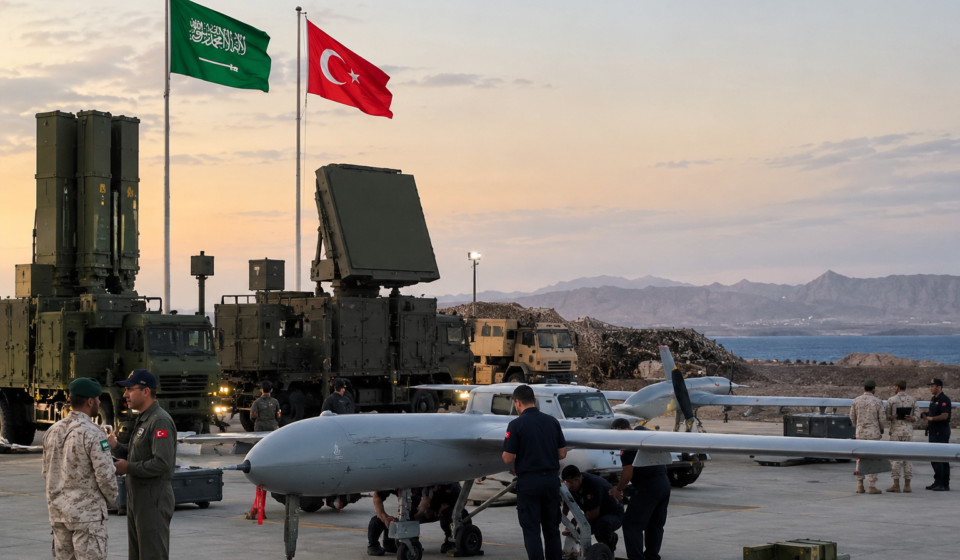

Turkey is preparing to expand technical and defensive military support for Saudi Arabia as the kingdom faces continued missile and drone attacks by Yemen’s Houthi movement, according to officials familiar with Ankara’s plans.
The assistance is expected to focus on protecting Saudi territory and critical infrastructure rather than sending Turkish forces into Yemen for offensive operations. Turkish officials and regional sources have indicated that Ankara could provide technical teams, air-defence capabilities, electronic warfare support and other military assistance as Saudi Arabia seeks to strengthen its defences.
The move comes after Saudi Arabia, Turkey and Pakistan agreed to move toward implementing their collective-defence commitments under the Makkah Joint Defence Agreement. The pact, signed in August, treats an armed attack against one of the three countries as an attack against all three, although the precise operational obligations are still being worked out.
Focus on Saudi Arabia’s defence
Turkey’s immediate role is expected to centre on defensive capabilities. Turkish officials have previously said Ankara could meet Saudi Arabia’s military requirements in certain technical areas.
Analysts cited by The National said Turkey was more likely to provide advisory assistance, border protection, air and missile defence systems and intelligence cooperation than to launch a large-scale operation involving Turkish troops inside Yemen. Turkish-made systems could also be operated by Saudi personnel with training and technical assistance from Turkey.
Reports have also indicated that Turkey has maintained technical teams and defensive equipment in Saudi Arabia, including systems intended to protect important infrastructure. Additional equipment and personnel could be deployed if the Turkish parliament authorises a broader military role.
Houthi attacks increase pressure on Riyadh
Saudi Arabia has faced a series of missile and drone attacks attributed to the Houthis, increasing pressure on Riyadh to reinforce its air-defence network.
Earlier reports said Saudi air defences intercepted ballistic missiles aimed at areas including Taif and Yanbu, while Houthi forces claimed attacks on Saudi targets. The escalation has also raised concerns over the security of energy infrastructure and important Red Sea trade routes.
The conflict has therefore pushed Saudi Arabia to seek greater cooperation with regional partners. France and Britain have also been involved in defensive measures around Saudi territory, while Pakistan and Turkey have been discussing their responsibilities under the Makkah defence agreement.
Turkey seeks to avoid direct Yemen intervention
Ankara has repeatedly presented the Makkah agreement as a defensive arrangement rather than an offensive alliance. Turkish Foreign Minister Hakan Fidan has said assistance could range from intelligence and logistics to ammunition and, depending on the scale of a threat, military units.
That distinction is significant because direct Turkish military involvement against Houthi positions inside Yemen could substantially widen Ankara’s role in the conflict.
For now, the reported preparations point primarily toward strengthening Saudi Arabia’s ability to detect and intercept missile and drone threats and protect its territory.
A new test for the Makkah defence pact
The developing Saudi-Houthi confrontation is becoming an early test of the Makkah Joint Defence Agreement between Saudi Arabia, Turkey and Pakistan.
While the agreement creates a framework for collective security, its practical implementation depends on each country’s domestic legal procedures and political decisions. Turkey, in particular, requires parliamentary approval for certain overseas military deployments.
The immediate emphasis from Ankara appears to be on defensive assistance, technical cooperation and protecting Saudi territory, rather than committing to a direct offensive campaign in Yemen.