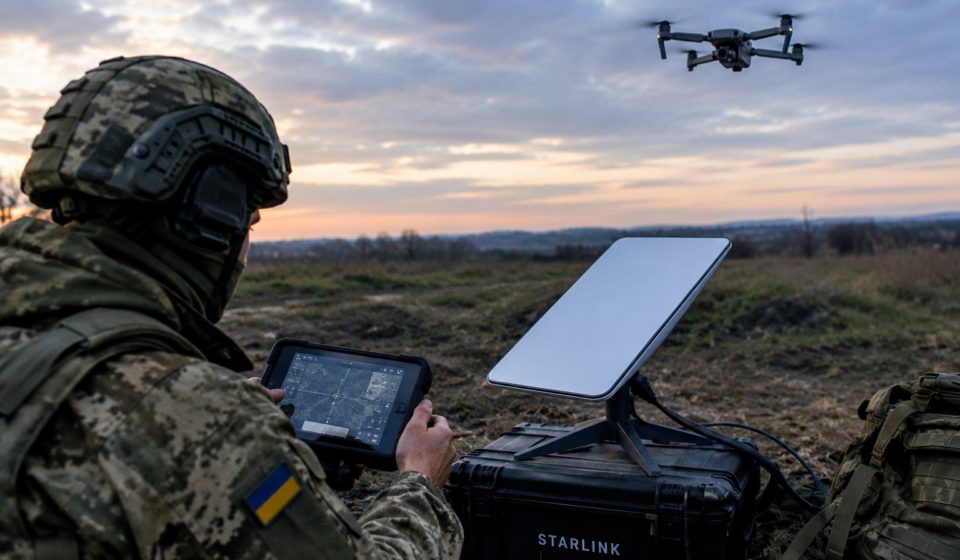

A temporary disruption affecting Starshield, SpaceX’s military-grade satellite communications system, has exposed Ukraine’s dependence on US-linked technology for battlefield communications and drone operations.
Ukrainian military personnel reported that connectivity restrictions affected some drone missions earlier this week, with commanders saying that communications interruptions caused mission failures and drone losses. Some Ukrainian units reported that their connections had returned to normal by Thursday, October 15, although questions remained about the cause of the disruption.
The incident has also raised concerns about Ukraine’s reliance on a communications system whose access and operating conditions are not entirely under Kyiv’s control. Reuters separately reported, citing two US officials and a Western official briefed on the matter, that an order to limit Starshield services for Ukraine came from inside the White House. The officials did not identify who made the decision.
What is Starshield?
Starshield is SpaceX’s satellite programme designed for government and national security customers. It builds on technology developed for Starlink, the company’s commercial satellite internet service, but is intended for more specialised missions.
According to the Associated Press, Starshield is designed to support secure communications, Earth observation and government operations that require additional security measures. It can incorporate dedicated satellites, specialised sensors and enhanced encryption for sensitive information.
Starlink, meanwhile, provides broadband internet through a large constellation of satellites in low Earth orbit. Its terminals have become important for maintaining communications in areas where conventional networks are unavailable, damaged or unreliable.
Although the two systems share technological foundations, they serve different purposes and are not interchangeable in every operational setting. Standard civilian Starlink access does not necessarily provide the specialised capabilities required for military missions.
Why does Ukraine rely on satellite connectivity?
Since Russia launched its full-scale invasion in February 2022, satellite communications have played an important role in Ukraine’s ability to maintain contact across the battlefield.
Military units use satellite internet to exchange information, coordinate operations and maintain communications when ground-based infrastructure is damaged or unavailable. Drone operators also rely on stable connections to receive live video, monitor flight conditions and maintain control of aircraft.
Ukraine’s battlefield systems increasingly depend on digital information. The Delta battlefield-management system, for example, helps military personnel organise and share operational data. Moving this information quickly and reliably is especially important when units and drones are operating in rapidly changing conditions.
The latest disruption demonstrated how interruptions to a communications link can affect several activities at once, from drone missions to frontline logistics.
What happened during the disruption?
Ukrainian officials reported that some satellite terminals experienced connectivity restrictions when moving at high speeds. Ukraine’s presidential adviser on defence technologies, Serhiy Beskrestnov, said the limitations affected military missions and that Ukrainian forces had not received advance warning.
Reuters reported that some terminals lost their connection for periods of around 10 to 20 seconds while travelling at speeds of approximately 110 to 120 kilometres per hour. Even brief interruptions can make a drone more difficult to control, particularly when it is moving quickly or operating in a demanding environment.
The Associated Press reported that a Ukrainian drone commander said several drones and other systems were affected and that some missions failed. By Thursday, some units said their connectivity had returned to the required level.
The precise cause of the restrictions was not immediately established publicly. The reports also did not establish that the entire Starlink network had been shut down across Ukraine. The reported problems concerned particular military connectivity and speed restrictions.
Who controls Starshield?
Control of access has become a central question in the dispute.
SpaceX chief executive Elon Musk said Starshield is owned and controlled by the US government, adding that decisions about its speed limits and permitted use ultimately rest with the US military and the president.
Reuters subsequently reported that officials had received a message from within the White House directing that the service for Ukraine’s military be limited. However, the officials cited by Reuters did not say who issued the order or who was responsible for implementing it.
These reports raise questions about the extent to which Ukraine can depend on US-controlled systems during military operations. They do not, on their own, establish the full decision-making chain or prove the motive behind the restrictions.
Why Europe cannot quickly replace the system
The disruption has also highlighted the limited availability of immediate alternatives.
In a report published on October 14, Reuters said European countries and companies were working on alternatives but could not offer a straightforward replacement for Ukraine’s military use of Starlink and Starshield.
Eutelsat’s OneWeb network provides satellite connectivity, but experts cited by Reuters said its existing architecture, terminal requirements and performance limitations made it less suitable for some frontline applications.
Switching networks would also require changes to equipment. Terminals designed for one proprietary system cannot necessarily connect directly to another provider’s satellites.
Europe is developing longer-term capabilities, including the European Union’s planned IRIS² satellite constellation and Germany’s military satellite programme. However, these projects do not provide an immediate, equivalent replacement for all the services Ukraine currently relies on.
What happens next?
The incident has strengthened calls for Ukraine and its partners to develop backup communications systems and reduce dependence on any single provider.
Alternative networks could improve resilience, but building a reliable replacement requires compatible equipment, sufficient coverage, secure communications and the ability to operate under battlefield conditions.
For Ukraine, the immediate priorities include maintaining communications for military units, ensuring reliable drone operations and clarifying the conditions under which access to critical satellite services can be restricted.
The disruption appears to have been temporary for at least some units, but its wider significance remains: access to satellite communications can have direct consequences for military operations, especially when a country has limited alternatives.