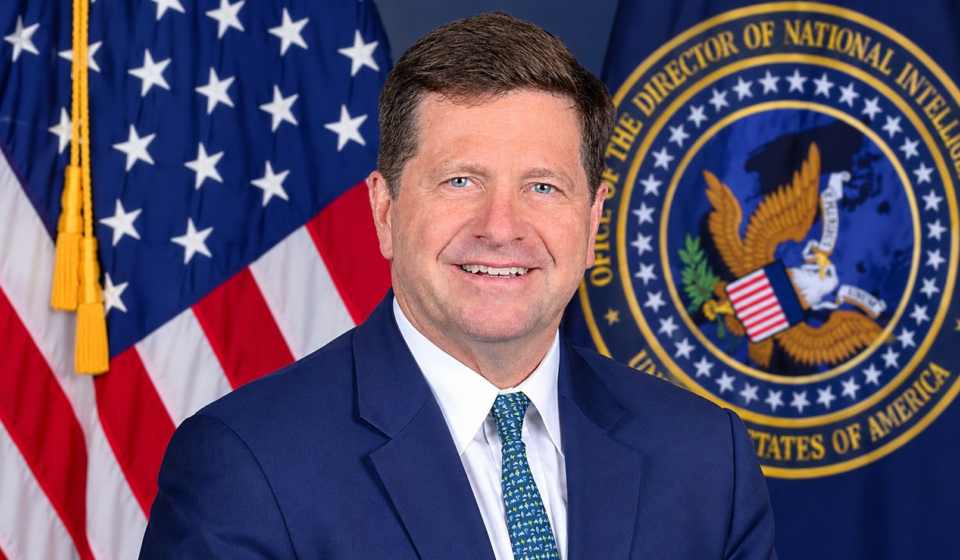

The head of US intelligence has delivered a pointed assessment of Vladimir Putin’s role in the war against Ukraine, saying the Russian president is not a friend of the United States when it comes to the conflict. The statement came amid renewed attention to President Donald Trump’s warm public language toward Putin during a meeting with the Russian and Chinese leaders in China.
Director of National Intelligence Jay Clayton made the distinction during an interview on ABC’s This Week on Sunday, November 22. His comments sought to separate diplomatic engagement between nuclear powers from the question of whether Moscow’s actions in Ukraine serve American interests.
Key Highlights
• Jay Clayton said Putin is “not America’s friend in Ukraine,” rejecting the idea that personal warmth changes the nature of Russia’s role in the war.
• Clayton defended Trump’s use of the word “friend” as appropriate within the context of discussions among the three major nuclear powers.
• Trump defended his personal description of Putin but declined to say whether the Russian leader was a friend of the United States.
The remarks highlight the challenge facing Washington as it tries to maintain diplomatic contact with Moscow while addressing Russia’s continuing war against Ukraine.
Jay Clayton Separates Diplomacy From Russia’s Actions in Ukraine
Speaking to ABC News anchor Jonathan Karl, Clayton was asked directly whether Putin should be considered a friend of the United States. His answer was specific to the war: Putin was not America’s friend in Ukraine, he said, adding that there was no ambiguity on that point.
Clayton did not present the statement as a rejection of diplomatic communication with Russia. Instead, he explained that Trump’s friendly language had been used in a particular setting: a meeting involving the leaders of the United States, Russia and China, three countries with major nuclear arsenals.
According to Clayton, the discussion was centred on the need to prevent a nuclear incident. In that context, he considered the president’s use of the word “friend” appropriate. His explanation drew a distinction between maintaining a working relationship with another world leader and agreeing with that leader’s policies or conduct.
That distinction is important because diplomatic conversations often require direct contact between governments that disagree sharply. However, the language used during such meetings can also carry political meaning, particularly when the conflict under discussion involves a country facing a large-scale invasion.
Trump’s Comments Put the Meaning of ‘Friend’ Under Scrutiny
The controversy followed Trump’s greeting to Putin during their recent meeting in Shenzhen, China, where Chinese President Xi Jinping also took part in discussions. Trump greeted the Russian leader warmly and referred to him as his friend.
The remark attracted attention because Russia remains at war with Ukraine, while Washington has been trying to find a path towards ending the conflict. The president’s language raised questions about whether his personal relationship with Putin reflected a broader change in the American approach to Moscow.
Trump defended the description by arguing that it was better to have a leader of a country possessing thousands of nuclear weapons as a friend rather than an enemy. His explanation focused on the risks associated with relations between nuclear-armed states and the value of keeping communication channels open.
However, when reporters later asked whether Putin was a friend of the United States as a whole, Trump did not give a direct endorsement. He responded that he could not speak for America.
That answer left room for a distinction between Trump’s personal relationship with Putin and the official interests of the US government. Clayton’s Sunday remarks addressed that gap by making clear that, in the context of Ukraine, Washington should not confuse diplomatic engagement with friendship.
Why the Ukraine War Remains Central to the Dispute
Russia launched its full-scale invasion of Ukraine in February 2022. The war has since reshaped European security, strained relations between Moscow and Western governments and created a major challenge for successive US administrations.
Russia continues to occupy substantial Ukrainian territory. Moscow has also maintained demands concerning the eastern Donbas region, including its insistence that Ukraine surrender the entire area as part of a potential settlement. Those demands remain a central obstacle in efforts to negotiate an agreement.
For Kyiv, any diplomatic arrangement must address the country’s sovereignty and security. For Washington, the challenge is to pursue negotiations without accepting terms that could leave Ukraine exposed to further military pressure.
Clayton’s comments did not announce a new US policy, a change in military assistance or a fresh sanctions decision. They were a public clarification of how the intelligence chief views Putin’s position in the specific context of the war.
That limitation matters. A senior intelligence official’s assessment can signal how the administration is describing a foreign leader’s actions, but it does not by itself establish what decisions the White House will take next.
European Allies React to Trump’s Warm Language
Trump’s remarks also drew criticism from European supporters of Ukraine. Polish Prime Minister Donald Tusk said Putin was not a friend of Poland and would never be one. His response reflected concern among countries close to the conflict that warm language towards the Russian president could weaken the message of support for Ukraine.
Ukraine’s President Volodymyr Zelensky also faced questions about Trump’s description of Putin. When asked about the comments, Zelensky did not offer a detailed public response and walked away.
The reactions show why the wording matters beyond Washington. European governments have a direct security interest in the outcome of the war, and they closely monitor signals from the United States because American diplomatic, economic and military decisions can influence the balance of support for Kyiv.
At the same time, the public disagreement does not necessarily mean that the United States and its European partners have abandoned coordination. It does, however, underline the difficulty of maintaining a common message when leaders use different language to describe Russia.
What Clayton’s Statement Does—and Does Not—Mean
Clayton’s intervention is best understood as a clarification rather than a policy announcement. He defended the diplomatic context of Trump’s interaction with Putin while refusing to describe Russia’s role in Ukraine as friendly to American interests.
The distinction leaves two separate questions. The first is whether Washington should communicate with Moscow to reduce nuclear risks and explore a possible end to the war. The second is whether Russia’s military objectives and demands are compatible with the security interests of the United States and Ukraine.
Clayton’s answer addressed the second question directly, while his defence of Trump’s language acknowledged the first. Neither statement, on its own, settles the future of negotiations or determines what terms Washington might support.
Strategic & Future Implications
The immediate significance of Clayton’s remarks lies in the effort to maintain a clear distinction between diplomacy and strategic alignment. The United States can engage with Russia because the consequences of a breakdown in communication between nuclear powers could be serious. But engagement does not require Washington to describe Russia as an ally or overlook the consequences of its invasion of Ukraine.
For Ukraine and its European partners, the next test will be whether this distinction is reflected in concrete decisions. The direction of US diplomacy, security commitments, intelligence cooperation and any future peace framework will carry more weight than personal descriptions exchanged at a summit. Clayton’s statement clarifies the administration’s public language on Putin and Ukraine; the practical meaning will depend on the policies that follow.