Jakarta Sees Two Sides of Public Opinion as Workers Back Prabowo and Women Challenge His Policies

Indonesia’s capital witnessed two contrasting demonstrations on Saturday as hundreds of workers rallied in support of President Prabowo Subianto while women’s rights activists and civil society groups marched against government policies. The parallel protests highlighted the different expectations, concerns and demands emerging among sections of Indonesian society.
The workers’ gathering, led by Labour Party chairman Said Iqbal, was organised to express support for Prabowo’s administration and call for national unity. Participants included representatives from labour unions and other groups associated with the coalition. Iqbal said the movement was prepared to mobilise its members across the country if it believed there was an attempt to destabilise the government.
Speaking at the rally, Iqbal urged Indonesians to respect the constitutional process and maintain political stability. He said changes in national leadership should take place through democratic and constitutional mechanisms. He also warned against violence, misinformation and actions that could create divisions.
The labour leader argued that several government initiatives were aligned with long-standing demands of workers. These included stronger employment protections, agrarian reform, measures concerning outsourcing and increases in minimum wages. He also referred to efforts to improve protections for domestic workers.
Iqbal said support for the president did not mean that workers would stop protesting over their own demands. He maintained that unions would continue to organise demonstrations when necessary, including campaigns seeking better wages and working conditions.
His remarks also drew attention because he indicated that union members could be mobilised in different towns and industrial centres if unrest emerged. The statement added a political dimension to what organisers described as a rally for unity and support for the elected government.
At the same time, another demonstration in Jakarta presented a sharply different picture. Women’s rights activists and civil society groups organised a march under the theme “Negara Menindas, Kita Lawan”, which translates roughly as “The State Oppresses, We Resist”.
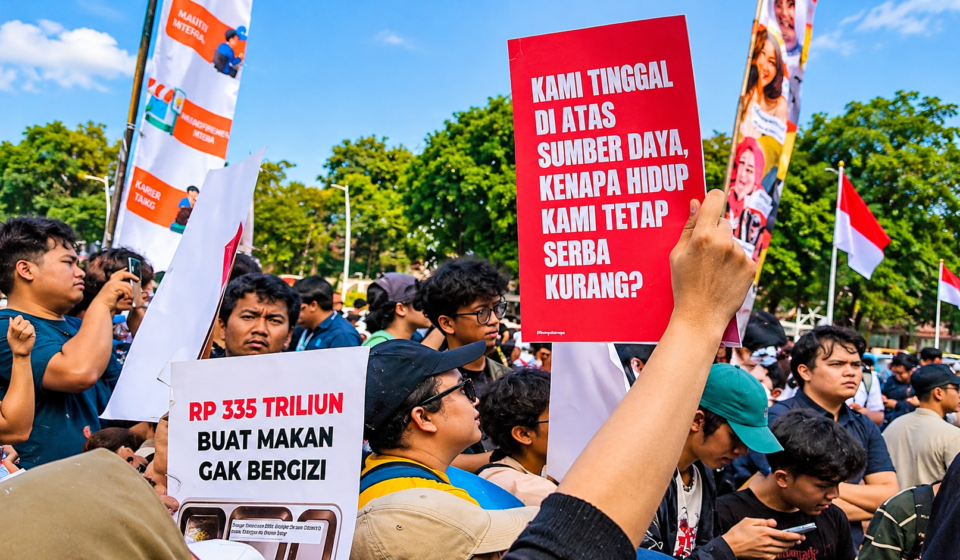
The march moved from the Sarinah area towards the Patung Kuda monument in central Jakarta. Participants raised slogans criticising government policies and demanding stronger protections for women and other vulnerable groups. The demonstration briefly became tense when some participants attempted to move past police barricades.
Organisers and participants put forward nine broad demands. These covered economic justice, social protection, access to essential services, protection against gender-based violence and discrimination, reproductive health rights, freedom of expression and stronger safeguards for human rights defenders.
The march also raised concerns about the cost of basic necessities and the economic burden faced by women. Participants called for greater recognition of unpaid care work and improved protection for workers, including migrant workers. Their demands extended beyond gender equality to include broader questions about public spending, civil liberties and environmental justice.
One issue highlighted by the demonstrators was the government’s free-meal programme. While the initiative is presented as a major social programme, critics at the march called for closer scrutiny of its costs and implementation. They also demanded action over concerns linked to the safety and effectiveness of public policies.
The response to Indonesia’s prolonged forest and land fires was another major point of criticism. Women’s groups argued that the government needed to address the environmental and public-health consequences of the fires, which have affected communities over an extended period. Activists also raised concerns about the impact of smoke and environmental damage on women, children and other vulnerable residents.
A further demand concerned a tax on women’s sanitary products. Protesters objected to the additional financial burden and called for policies that better recognise essential menstrual health needs. The issue became part of a wider discussion about the affordability of basic goods and access to healthcare.
The two demonstrations took place against a backdrop of growing political debate over Prabowo’s administration. His government has pursued high-profile populist programmes, including the free-meal initiative, while facing questions about public expenditure, implementation and investor confidence. Discontent has also been reported over the handling of forest fires and other policy issues.
Political tensions have been further complicated by a police investigation into allegations that senior officials attempted to intercept the president’s communications. Police have named four senior police officials as suspects in the case. One of them is a former police chief associated with former president Joko Widodo, widely known as Jokowi.
The case has exposed strains between Prabowo and his predecessor, who was also a political backer during the presidential transition. Jokowi has said he respects the legal process, while a lawyer for one of the suspects has indicated that the client would cooperate with the investigation. The allegations remain subject to the legal process and should not be treated as established guilt.
Saturday’s events followed student demonstrations against the administration in recent months, including protests reported in Jakarta and other cities. Together, these developments point to a public environment in which support for the government and criticism of its decisions are being expressed through competing forms of mobilisation.
The workers’ rally showed that sections of organised labour see reasons to support the administration, particularly where they believe its policies overlap with employment and welfare demands. The women’s march, meanwhile, demonstrated that other groups remain dissatisfied with the government’s approach to gender rights, economic pressures, environmental concerns and civil liberties.
The demonstrations do not, by themselves, establish the overall level of public support or opposition to Prabowo. They do, however, underline the range of issues confronting his government as it seeks to implement major programmes while responding to criticism from civil society.
For Indonesia, the challenge will be to ensure that public demonstrations remain peaceful and that competing demands can be addressed through democratic institutions. The contrasting rallies in Jakarta made one point clear: support for the president and demands for changes in government policy are both visible parts of the country’s current political debate.