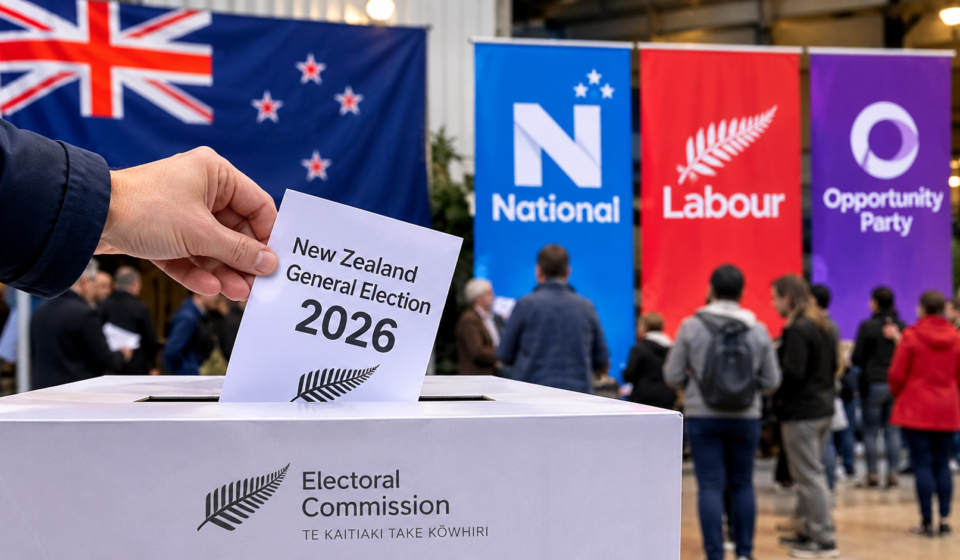

New Zealand’s general election has produced a closely fought contest between the ruling National Party and the opposition Labour Party, while a political newcomer, the centrist Opportunity Party, is emerging as a potentially decisive force in determining the country’s next government.
Early counting showed National and Labour each securing just under 30 per cent of the party vote, leaving neither major political force with a clear mandate to govern alone. The result has placed smaller parties at the centre of negotiations over the country’s political future, with Opportunity attracting particular attention after appearing to cross the threshold required to enter Parliament.
Led by Qiulae Wong, the Opportunity Party is seeking to translate its election performance into parliamentary influence. Its position could become especially important if the two major political blocs remain unable to secure a dependable majority.
National and Labour locked in a close contest
The election has turned into a major test for Prime Minister Christopher Luxon and his centre-right National Party. Luxon came to power after the 2023 election, ending six years of Labour-led government. He is now seeking another term amid public dissatisfaction over economic conditions, household expenses and the government’s performance.
Labour, led by Chris Hipkins, is attempting to return to office after losing power in 2023. The party has campaigned on improving public services, making healthcare and transport more affordable, and easing the financial pressure on households.
Early results indicated that both parties were polling below 30 per cent, demonstrating how difficult it has been for either major party to dominate the political contest.
The outcome also reflects growing voter interest in alternatives to the traditional National-Labour rivalry. Smaller parties have attracted support from people dissatisfied with the established political choices.
Opportunity Party crosses an important threshold
The Opportunity Party’s performance has become one of the most closely watched developments in the election. Under New Zealand’s mixed-member proportional representation system, a political party generally needs at least 5 per cent of the party vote or one electorate seat to qualify for parliamentary representation.
Early results placed Opportunity above the 5 per cent threshold, potentially giving it several seats in Parliament for the first time.
That achievement could provide the party with influence far beyond its share of the national vote. If neither National nor Labour can assemble enough parliamentary support through existing partners, Opportunity’s representatives could become important in deciding which side forms the next government.
Party leader Qiulae Wong has presented Opportunity as a centrist alternative to the established political blocs. The party’s proposals include a land value tax, an idea that has drawn criticism from National because it conflicts with the governing party’s promise not to introduce new taxes.
Opportunity has indicated that it is prepared to negotiate with the party that receives the largest number of votes. However, National leader Christopher Luxon has previously ruled out entering a governing arrangement with it, creating uncertainty over how the party’s parliamentary influence might translate into an actual coalition agreement.
New Zealand’s electoral system makes smaller parties important
New Zealand uses a mixed-member proportional, or MMP, electoral system. Voters cast two ballots: one for a local electorate candidate and another for a political party.
The party vote largely determines how many seats each party receives in Parliament, while electorate victories also play an important role in the final allocation.
This system makes coalition governments common. A party can finish first in the national vote but still need support from smaller parties to secure a parliamentary majority.
The Parliament normally has 120 seats, meaning 61 votes are required for a straightforward majority. However, electorate results can create additional seats, known as an overhang, and increase the size of Parliament.
That possibility is particularly relevant in the current election. Different early projections have produced slightly different calculations of the parliamentary balance, meaning the final coalition arithmetic remains uncertain.
The result is therefore not simply a contest over which party finishes first. The more important question is which combination of parties can command enough support to govern.
Cost of living dominates the election campaign
Economic pressure has been one of the central issues shaping voter decisions. The campaign has focused heavily on grocery prices, housing costs, employment, healthcare and the ability of ordinary households to manage everyday expenses.
The election has even been described as a supermarket election because food prices and competition among major grocery retailers became prominent political issues.
National has promised to restore the government budget to surplus through tighter fiscal management while maintaining its broader economic approach. Labour has placed greater emphasis on affordable healthcare and transport, investment in infrastructure and stronger public services.
Smaller parties have also used economic concerns to distinguish themselves. The Greens, for example, have proposed stronger government involvement in the energy and supermarket sectors, alongside tax changes. Other parties have put forward different approaches to employment, immigration and public spending.
The close result suggests that voters have not given either major party an overwhelming endorsement of its economic programme.
Coalition negotiations could take weeks
Although preliminary results provide an indication of the political balance, they do not settle the question of who will become prime minister.
New Zealand’s Electoral Commission is expected to publish the official final results on November 27. These will include special votes, such as ballots cast by overseas voters and people voting outside their electorates.
Such votes can change party percentages and parliamentary seat allocations. Until the official count is completed, parties may be reluctant to finalise coalition agreements.
The negotiations could involve National, ACT New Zealand and New Zealand First on the centre-right, while Labour may seek support from the Greens and potentially other parties. Opportunity’s role will depend on the final seat distribution and whether any governing combination can secure sufficient parliamentary backing.
Former New Zealand minister Peter Dunne has indicated that the Opportunity Party could become an important participant if the major political blocs remain closely matched. Its ability to negotiate with either side, however, will depend on the positions adopted by the larger parties.
Political uncertainty continues after polling day
The election has highlighted a changing political landscape in New Zealand, where support for smaller parties is making it increasingly difficult for the two traditional rivals to govern without partners.
For Luxon, the result represents a test of his leadership and the public’s confidence in the current government’s economic direction. For Hipkins, it offers an opportunity to bring Labour back to power, but the party may still need substantial support from other political groups.
For Wong and the Opportunity Party, crossing the parliamentary threshold could mark a major breakthrough. Whether that breakthrough becomes influence over the next government will depend on the final count and the negotiations that follow.
With the official results still pending, New Zealand faces the possibility of an extended period of political discussions before a new government takes shape. The election has made one point clear: the next government may be decided not only by the two largest parties, but also by the smaller political forces that now hold a significant share of parliamentary power.