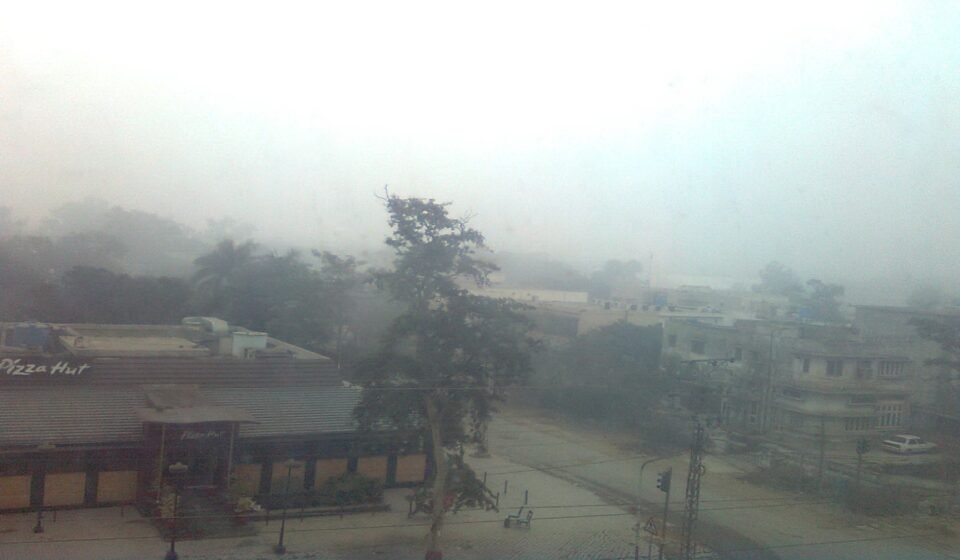

A fresh cross-border pollution dispute has emerged between Pakistan and India after Punjab’s senior minister Marriyum Aurangzeb blamed smoke from Diwali fireworks in neighbouring Indian regions for worsening air quality in Lahore.
The Pakistani minister alleged that polluted air travelled from Indian Punjab towards Lahore through the eastern corridor, adding to the city’s already serious smog problem. Her statement has brought renewed attention to the challenge of controlling air pollution across an international border, where weather conditions can carry smoke and other pollutants from one region to another.
The allegation comes as Lahore experienced extremely poor air quality around the Diwali period, prompting concerns about the health of residents and the effectiveness of pollution-control measures.
Pakistan’s minister accuses India of adding to Lahore’s pollution
Marriyum Aurangzeb, Punjab’s senior minister responsible for environmental matters, said smoke from Diwali fireworks in Indian cities had contributed to the deterioration in Lahore’s air quality.
She identified areas including Amritsar, Ludhiana, Jalandhar, Patiala, Bathinda and Ferozepur as possible sources of polluted air moving towards Pakistan.
According to her statement, easterly winds carried pollution across the border, while low wind speeds and unfavourable weather conditions made it harder for pollutants to disperse.
The minister also referred to pollution readings from several Indian locations near the Pakistan border. She said the situation required continuous monitoring and urged residents to follow health and safety advisories issued by Punjab’s Environmental Protection Agency.
Her comments have placed the spotlight on the environmental connection between the two neighbouring countries, particularly during the winter months when smoke and fine particles can remain trapped close to the ground.
Lahore records extremely high pollution levels
Lahore experienced a sharp rise in air pollution on November 9. The city’s Air Quality Index reached around 590 during the morning hours on one monitoring platform, placing it in the hazardous category.
Some individual monitoring stations reported even higher readings. The situation improved later in the day as weather conditions and wind movement changed.
Punjab’s senior minister subsequently said the city’s overall AQI had fallen to 208. Later readings also showed further improvement, although the air remained unhealthy.
On November 10, Lahore continued to rank among the world’s most polluted major cities. A separate reading placed its AQI at 263, illustrating that the pollution problem had not disappeared.
Different readings can vary according to the monitoring station, measurement period and calculation method. They should therefore not be treated as identical measurements.
Why Indian Punjab has become part of the dispute
The geographical distance between Lahore and several Indian Punjab cities makes cross-border movement of air pollution a serious environmental concern.
Amritsar is approximately 50 kilometres from Lahore, while other cities such as Ferozepur, Jalandhar and Ludhiana are also located within the wider region.
When winds blow from the east towards Pakistan, smoke and fine particles generated in Indian territory can potentially travel across the border. Fireworks release particulate matter and other pollutants, while agricultural residue burning can produce large amounts of smoke.
Pakistan’s Punjab government had issued a special assessment on November 8 warning that smoke from Diwali fireworks could reach Lahore within five to 13 hours, depending on wind conditions.
The assessment also highlighted crop-residue burning in Indian Punjab as a possible contributor to pollution in border areas.
However, identifying the exact share of Lahore’s pollution coming from India requires detailed scientific measurements, including wind direction, atmospheric conditions and the chemical composition of airborne particles.
Pakistan also faces pollution from local sources
Although the minister has blamed cross-border pollution, Lahore’s air quality problem is not limited to smoke arriving from India.
Vehicle exhaust, industrial emissions, construction dust, waste burning and agricultural fires within Pakistan also contribute to the city’s poor air quality.
A separate assessment of Lahore’s pollution found that the city’s nighttime particulate matter concentration was already high before Diwali. This indicates that the city was facing substantial pollution pressure even before the festival’s fireworks.
Pakistan’s own Punjab province has also reported agricultural fire incidents. Authorities have been carrying out enforcement operations against crop-residue burning, using surveillance teams, drones and firefighting units.
The presence of pollution sources on both sides of the border makes the issue more complicated. Even if smoke travels from one country to another, local emissions can continue to worsen the situation.
Pakistan intensifies anti-smog operations
The Punjab government has said that it is taking several steps to control pollution and improve air quality in Lahore.
These measures include deploying anti-smog guns, inspecting industrial facilities, monitoring brick kilns and taking action against agricultural residue burning.
Authorities have also used field teams and satellite-based fire detection systems to identify possible burning incidents.
The government has urged residents to avoid unnecessary outdoor activities during periods of severe pollution. Children, older people, pregnant women and those with heart or respiratory conditions have been advised to take extra precautions.
Residents have also been encouraged to avoid burning rubbish and dry leaves, keep windows closed when outdoor pollution is high and follow official health advisories.
Aurangzeb credited improved weather conditions, stronger winds and government operations for the reduction in Lahore’s pollution readings later on November 9.
Scientific evidence needed to settle the blame
The latest dispute highlights a difficult question: how much of Lahore’s toxic air came from Indian fireworks, and how much was generated by pollution sources inside Pakistan?
The movement of air across national borders is a well-established atmospheric process. However, proving the contribution of a particular event requires more than observing that pollution increased after it happened.
Scientists need to compare pollution measurements before and after the fireworks, study wind patterns and examine the chemical signatures of particles in the air. Such analysis can help distinguish fireworks-related pollution from smoke produced by agricultural fires, vehicles and industrial activity.
Without this evidence, assigning responsibility entirely to one country would be premature.
The issue also points to the need for cooperation between India and Pakistan on air-quality monitoring. Sharing pollution data, satellite observations and weather information could help both sides identify pollution sources more accurately.
For residents of Lahore, the immediate concern remains the quality of the air they breathe. The latest allegations may intensify the political debate between the neighbours, but lasting improvement will require action against pollution sources on both sides of the border.