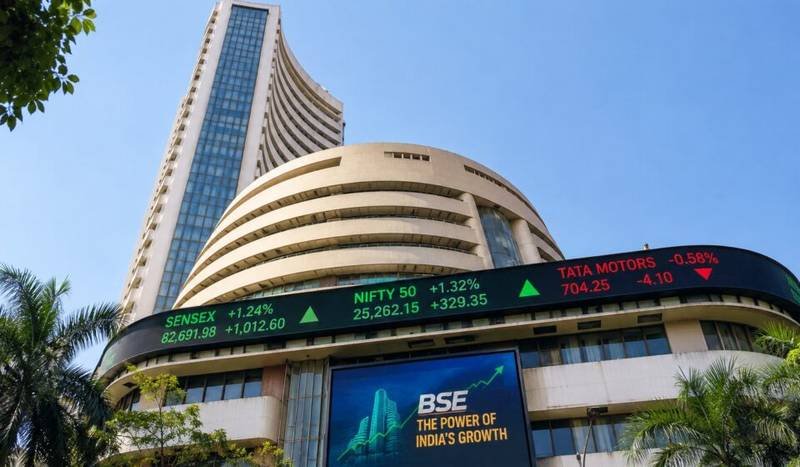

Indian equity markets are heading into Friday’s session with investors watching a combination of elevated crude oil prices, corporate earnings and international market movements. After three consecutive sessions of losses, traders will be looking for signs of stabilisation while remaining cautious about inflation risks and geopolitical uncertainty.
The BSE Sensex fell 460.30 points, or 0.62%, to finish Thursday at 73,249.39. The NSE Nifty 50 declined 123.70 points, or 0.54%, to close at 22,687.65. Selling pressure extended across several sectors, reflecting concerns about higher energy costs and uncertain global conditions.
1. Crude oil remains a major market driver
Oil prices are likely to remain one of the most important indicators for Indian equities. Renewed tensions in the Middle East have raised concerns about energy supplies, keeping international crude prices above $110 a barrel during recent trading.
India imports a substantial share of its crude oil requirements, making the economy sensitive to sustained increases in energy prices. Expensive oil can raise transportation and manufacturing costs, add to inflationary pressure and affect corporate profit margins.
Investors may therefore pay particular attention to oil marketing companies, aviation businesses, transport operators and other sectors exposed to fuel costs. The direction of crude prices could also influence expectations for inflation and monetary policy.
2. Corporate earnings put individual stocks in focus
The September-quarter earnings season is providing company-specific triggers for the market. Results announced after Thursday’s closing bell may lead to significant price movements as investors compare revenue growth, profitability and management commentary with expectations.
Among the companies attracting attention are Swiggy, Hindustan Petroleum Corporation, Colgate-Palmolive India, Sagility and Adani Total Gas.
Swiggy reported a consolidated net loss of ₹922 crore for the September quarter, narrower than the ₹1,092 crore loss recorded a year earlier. Revenue increased approximately 36% year on year to ₹7,571 crore.
Hindustan Petroleum Corporation reported a year-on-year decline of about 6% in quarterly net profit to ₹3,625 crore, although its performance improved substantially compared with the previous quarter.
Colgate-Palmolive India reported a 4% increase in net profit to ₹341.5 crore, while revenue grew around 12% to ₹1,705.7 crore. Investors will also assess the company’s operating margins.
Sagility reported net profit growth of approximately 13% to ₹284 crore, supported by revenue growth. Adani Total Gas recorded a modest rise in quarterly profit, alongside stronger revenue.
These results could influence the respective shares independently of the broader market direction.
3. Global markets and technology stocks
International market movements remain another important influence. US equities experienced a sharp reversal on Thursday as investors reconsidered the cost and expected returns of large artificial intelligence investments.
The Nasdaq Composite dropped approximately 2.6%, while the S&P 500 declined about 1.2%. Semiconductor shares were particularly weak, reflecting concerns about spending on AI infrastructure and future profitability.
For Indian investors, these movements may affect sentiment towards information technology companies and other businesses linked to global technology spending. However, domestic share prices will also depend on company-specific developments, valuations and local institutional flows.
Investors should avoid assuming that a fall in overseas technology shares will produce an identical move in every Indian IT stock.
4. What to watch in the Sensex and Nifty
After Thursday’s decline, traders will monitor whether the Nifty 50 can stabilise around recent trading levels or faces further selling pressure. The previous close of 22,687.65 provides a reference point for the session, but it does not guarantee that the index will hold above that level.
On the upside, a sustained recovery would need support from improved market breadth, stronger buying interest and more stable global cues. Persistent selling, rising crude prices or disappointing earnings reactions could weigh on sentiment.
Intraday movements can change rapidly, so investors should use updated exchange data rather than relying exclusively on pre-market estimates or previously published technical levels.
5. Key factors to monitor before trading
Market participants may keep the following developments on their watchlist:
• Crude oil: Further increases could intensify concerns about inflation and corporate costs.
• Quarterly results: Revenue, margins, profits and management guidance may drive individual shares.
• Global technology stocks: Weakness in overseas semiconductor and AI-related companies could influence sentiment towards Indian technology shares.
• Foreign and domestic institutional activity: Net buying or selling may affect market direction.
• Geopolitical developments: Any change in Middle East tensions could influence oil prices and risk appetite.
What could shape Friday’s session?
The market’s direction on October 23 will depend on how investors balance concerns about energy prices and international uncertainty against opportunities emerging from corporate earnings.
The recent decline does not necessarily mean that every sector or stock will continue falling. Companies with resilient earnings, manageable costs and stronger balance sheets may respond differently from businesses that are more exposed to expensive energy or uncertain demand.
For retail investors, the focus should remain on verified company disclosures, current market prices and individual risk tolerance rather than short-term predictions.
Bottom line: Oil prices, earnings reactions and global sentiment are the main factors to watch as Indian markets begin Friday’s session. Market conditions may remain volatile, and no particular opening direction or trading outcome is guaranteed.