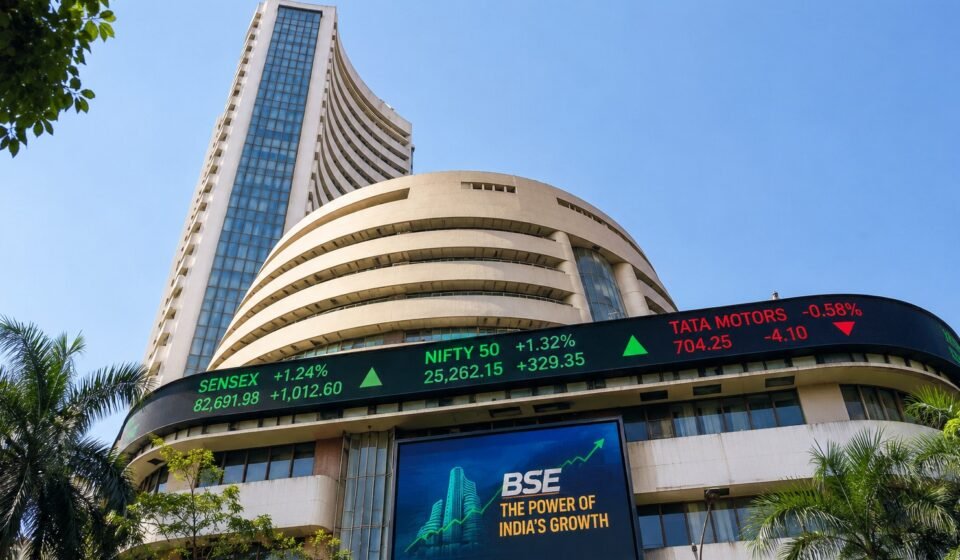
Stock Market Today: Sensex and Nifty Face Fresh Test as Crude Oil, Fed Decision and Earnings Take Centre Stage

Indian equity markets enter Monday’s trading session facing several competing influences, with elevated crude oil prices, persistent global uncertainty and a busy corporate earnings calendar likely to shape investor sentiment. After a difficult week for domestic equities, traders will be watching global market signals and company-specific developments for indications of the market’s next direction.
The upcoming US Federal Reserve policy decision, scheduled for October 28, is another major event for investors. Meanwhile, the expected stock market debut of Jio Platforms later this week is drawing attention to India’s primary market.
The immediate challenge for investors is to assess whether corporate earnings and domestic investment flows can offset concerns over expensive energy imports, currency pressure and foreign investor selling.
Sensex and Nifty Enter the Week After a Decline
Indian equities ended the previous trading week under pressure. During the holiday-shortened week, the BSE Sensex lost approximately 1,605 points, or 2.15%, while the Nifty 50 declined about 546 points, or 2.36%, according to market reports published on October 25.
The declines reflected concerns about rising oil prices, geopolitical tensions and uncertainty surrounding global interest rates. Selling also extended beyond the largest companies, indicating that investors were reducing exposure across several parts of the market.
The weakness in broader-market shares is particularly important because mid-cap and small-cap stocks can experience sharper price movements when investors become more cautious. Lower liquidity and elevated volatility can magnify losses in these segments.
For Monday, traders are likely to assess the latest global cues, movements in crude oil and the rupee, and developments in the domestic earnings season before making decisions.
Investors should also distinguish between an opening movement and a sustained recovery. A positive start, if it occurs, would not necessarily indicate that the recent selling pressure has ended.
Five Factors Likely to Influence Trading
1. Crude Oil Prices Remain a Major Concern
Energy prices remain among the most important variables for the Indian stock market. Rising crude oil prices can increase the country’s import bill, put pressure on the rupee and complicate the inflation outlook.
India imports a substantial share of its crude oil requirements, making domestic markets sensitive to supply disruptions and geopolitical developments in major producing regions.
Higher oil prices can affect companies differently. Fuel retailers may face pressure on marketing margins if retail prices do not adjust sufficiently. Airlines can experience higher operating costs, while paint manufacturers, tyre companies and other businesses dependent on petroleum-based inputs may face increased expenses.
Oil producers and certain energy-related businesses can experience different effects, depending on their production, pricing arrangements and operating costs.
Investors will therefore be watching crude prices alongside developments in West Asia. A sustained rise in energy prices could weigh on market sentiment, while a meaningful easing of supply concerns could reduce some of the pressure on Indian equities.
2. The US Federal Reserve’s Decision on October 28
The Federal Reserve’s two-day policy meeting, beginning October 27, is expected to be a central global market event.
Investors will study the interest-rate decision and accompanying policy statement for clues about the future direction of US monetary policy. The tone of the central bank’s communication may be as important as the decision itself.
If policymakers emphasise persistent inflation and the need to maintain restrictive financial conditions, US bond yields and the dollar could face upward pressure. Such a development may make emerging-market investments less attractive to some international investors.
A more balanced assessment of inflation and economic growth could support risk appetite, although the market reaction would also depend on other economic data and corporate earnings.
For Indian equities, the key question is how the Fed’s guidance affects global liquidity, foreign investment flows and the rupee.
3. Jio Platforms’ Expected Market Debut
Jio Platforms is scheduled to list on the Indian stock exchanges on October 28, making it one of the week’s most closely watched market events.
The listing will attract attention from investors who applied for shares as well as those assessing the outlook for India’s primary market.
Market participants will examine the listing price, trading volumes and investor response to evaluate demand for the company’s shares. The performance could also influence sentiment toward other large public offerings.
However, a strong or weak debut would not necessarily determine the direction of the wider market. The Sensex and Nifty will continue to respond to global conditions, institutional flows, earnings announcements and changes in economic expectations.
Investors should also avoid treating unofficial grey-market premiums as reliable predictions of the listing price. Such indicators are unregulated, can change rapidly and may not reflect the price at which shares ultimately trade.
4. Quarterly Results From Major Companies
The September-quarter earnings season will remain an important source of stock-specific movement.
Companies scheduled to announce results during the week include TVS Motor, Asian Paints, Trent, Sun Pharma, Bharat Electronics, Indian Oil, Bank of Baroda and GAIL India. Additional announcements from major automobile, technology, consumer and infrastructure businesses may also affect sector sentiment.
Investors will be looking beyond headline profit figures. Revenue growth, operating margins, management commentary, demand conditions and forward guidance can all influence how the market interprets a company’s results.
For example, stronger sales may fail to support a share price if higher input costs significantly reduce margins. Conversely, a company reporting modest earnings growth could receive a favourable response if its outlook improves.
Oil-sensitive businesses deserve particular attention because higher energy prices can influence their operating expenses. Companies with strong pricing power or lower dependence on imported inputs may be better positioned to manage cost increases, although outcomes will vary by business.
5. Foreign Investor Activity and the Rupee
Foreign institutional investor activity will be another factor to monitor. Sustained foreign selling can add pressure to benchmark indices, particularly when it coincides with rising global bond yields or a stronger US dollar.
Domestic institutional investors can help absorb some of that selling, but the balance between foreign and domestic flows may change from session to session.
Currency movements also matter. A weaker rupee can increase the cost of imported raw materials and energy, while companies earning a substantial portion of their revenue overseas may experience different effects depending on their cost structures and currency exposure.
Investors will therefore be watching institutional-flow data and the rupee alongside equity-market movements rather than interpreting index performance in isolation.
What Traders Should Watch on Monday
The main task for traders will be to determine whether the market can stabilise after the previous week’s losses.
The Nifty 50’s recent performance suggests that investors should pay attention to price action around nearby support and resistance areas. Technical levels published by analysts are estimates based on past trading behaviour, not guaranteed turning points.
A sustained improvement in market breadth, with more shares advancing than declining, would provide a different signal from a rally driven by only a handful of heavyweight stocks. Trading volumes and the performance of banking, information technology, pharmaceutical and energy shares may also help investors assess the strength of any recovery.
Market participants should be cautious about reacting to isolated headlines or short-term price swings, especially ahead of the Federal Reserve decision and several major earnings announcements.
Outlook: Volatility May Continue
Indian markets begin the week with a packed calendar and several unresolved external risks. Crude oil prices, geopolitical developments, US monetary policy and foreign investment flows could influence the direction of the Sensex and Nifty, while company earnings and Jio Platforms’ listing may create additional stock-specific opportunities and risks.
The outcome will depend on how these factors interact. Better-than-expected earnings or easing energy concerns could support sentiment, while renewed geopolitical stress, a stronger dollar or disappointing corporate guidance could prolong market uncertainty.
For investors, the emphasis should remain on verified company information, valuation, financial strength and risk management rather than attempts to predict every short-term movement.