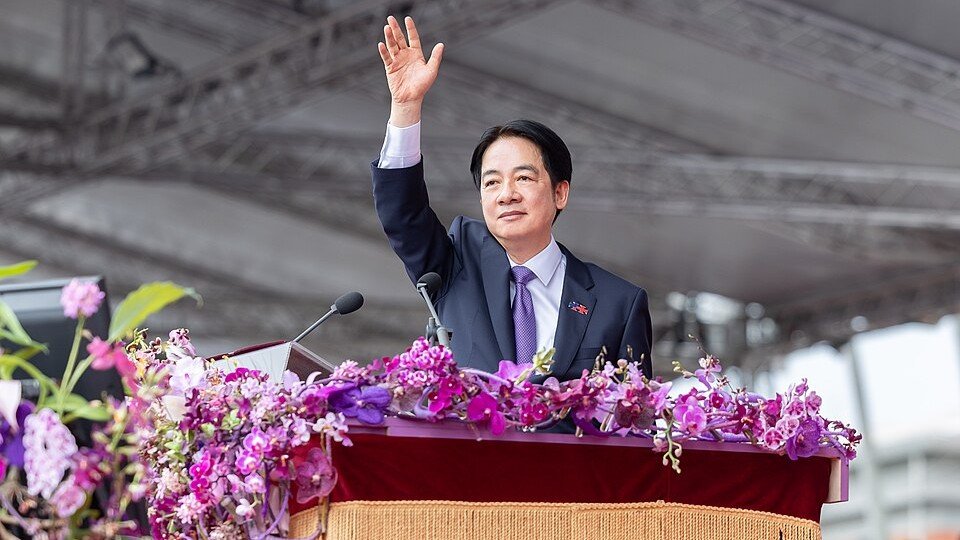

Taiwanese President Lai Ching-te has reaffirmed the island’s commitment to peace while declaring that it will not give up its freedom or accept subordination to China. His remarks came during Taiwan’s National Day celebrations on Saturday, as tensions across the Taiwan Strait continue to shape regional security.
Speaking outside the Presidential Office in Taipei, Lai said Taiwan wanted peaceful relations and dialogue but insisted that the rights and future of its people must be respected.
“Taiwan cherishes peace, but we will not give up our freedom. We are open to exchanges, but will not accept subordination,” Lai said, according to Reuters.
His address placed particular emphasis on the relationship between national defence and diplomacy, with the president arguing that stronger self-defence could help prevent conflict rather than provoke it.
Lai Says Defence Spending Is Intended to Deter War
Taiwan has been increasing investment in its military capabilities and modernising its armed forces amid pressure from China, which claims the island as part of its territory.
Lai said the purpose of strengthening Taiwan’s defences was to deter a potential conflict. He argued that improving military preparedness would also help create conditions for dialogue conducted on the basis of equality and dignity.
“Our aim by increasing investment in national defence is not to provoke; rather, it is to deter war,” Lai said.
The president added that strengthening self-defence was not a rejection of negotiations. Instead, he presented defence preparedness as a way to support meaningful dialogue and protect Taiwan’s democratic way of life.
Taiwan faces a significant military imbalance with China, which has a much larger armed force and continues to expand its military capabilities. Taipei’s defence modernisation efforts are therefore closely linked to concerns about the island’s security and the risk of escalation in the region.
China-Taiwan Tensions Remain a Regional Concern
China regards Taiwan as part of its territory and has not ruled out the use of force to bring the island under its control. Taiwan, meanwhile, is governed democratically and maintains its own political institutions, military and administration.
The two sides have been governed separately since 1949, following the Chinese Civil War. Their competing positions on Taiwan’s status remain a central source of tension in East Asia.
Beijing has criticised Lai in the past, describing him as a separatist, and has rejected his repeated offers for talks. China’s Taiwan Affairs Office had not immediately responded to the latest National Day speech, Reuters reported.
Lai’s comments underline Taipei’s position that peace should be pursued through dialogue, but not through pressure that would require Taiwan to surrender its political autonomy.
President Says Peace Cannot Depend on Wishes Alone
During his address, Lai argued that peaceful intentions alone could not guarantee stability. He said the international community faced a broader question over whether military power should be allowed to override rules or deprive people of the ability to determine their future.
His remarks also highlighted the importance of international support for stability in the Indo-Pacific region, where tensions involving China, Taiwan and the United States have become a major security concern.
The United States has long maintained unofficial relations with Taiwan and provides support for the island’s self-defence. Any escalation across the Taiwan Strait could have wider implications for regional security, trade and global technology supply chains.
Taiwan is an important part of the global semiconductor industry, making stability around the island significant for businesses and economies well beyond East Asia.
Taiwan Keeps the Door Open to Dialogue
Despite his firm language on freedom and defence, Lai reiterated that Taiwan remained open to exchanges and peaceful engagement.
His message sought to draw a distinction between dialogue conducted with mutual respect and negotiations pursued under military or political pressure. The president said Taiwan’s efforts to strengthen its defences were intended to make peaceful engagement possible on more equal terms.
Whether this approach can reduce tensions will depend on developments in cross-strait relations and the willingness of both sides to engage. China’s position on Taiwan remains fundamentally different from that of Taipei’s current leadership.
For now, Lai’s National Day address signals that Taiwan intends to continue strengthening its security while publicly maintaining its commitment to peace and dialogue.