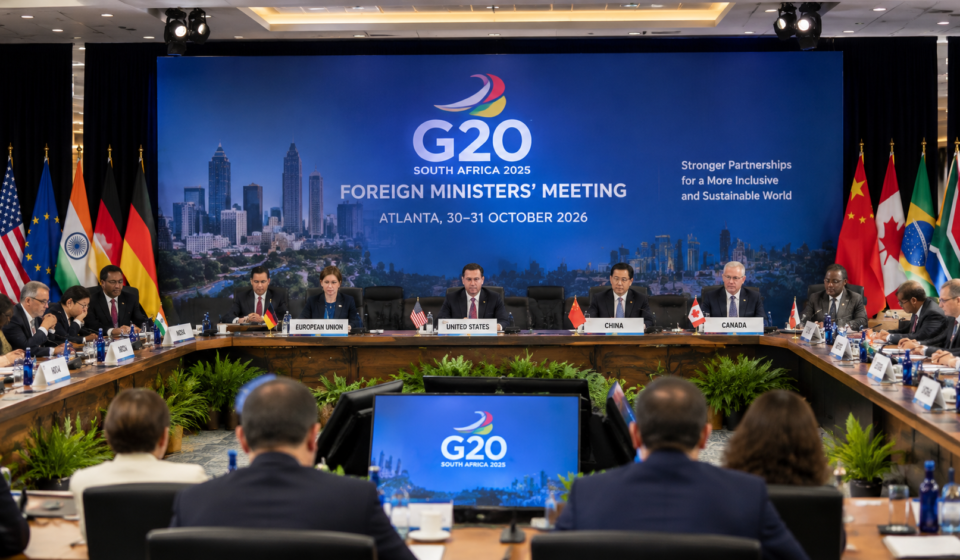

A growing diplomatic divide over Russia’s war in Ukraine disrupted the opening of the G20 foreign ministers’ meeting in Atlanta, after the United States cancelled a traditional group photograph because several delegations objected to appearing alongside Russian Foreign Minister Sergey Lavrov.
The photograph, commonly known as the G20 “family photo,” is a ceremonial part of major international gatherings. Its cancellation highlighted the difficulty of presenting a united front among the world’s leading economies while disagreements over Russia, Ukraine and wider international security continue to strain relations between Western governments.
The two-day meeting is being hosted by US Secretary of State Marco Rubio. The discussions are intended to address international economic and security challenges, including energy supplies, global trade and freedom of navigation. However, the dispute surrounding Lavrov’s attendance became an early sign of the political tensions facing the gathering.
Why the United States Cancelled the Photograph
US officials said the decision was taken after it became clear that some delegations would not participate in a joint photograph with Lavrov. Washington wanted to prevent a ceremonial event from turning into a public confrontation that could overshadow the substantive discussions.
A Western diplomat said roughly one-third of participants, including representatives from Australia and Canada, opposed being photographed alongside the Russian foreign minister.
Germany also made its position clear. Foreign Minister Johann Wadephul said there could be no joint photograph featuring European partners and Lavrov because relations with Russia could not be treated as normal under the current circumstances.
European representatives had reportedly considered an alternative arrangement involving two separate photographs—one including Lavrov and another without him. The United States ultimately decided to abandon the photo opportunity altogether.
The cancellation did not stop the meeting itself. Foreign ministers continued with their scheduled discussions, although the disagreement exposed the political sensitivities surrounding Russia’s participation.
Russia’s Presence Remains a Source of Division
Lavrov’s attendance has become a contentious issue for several Western governments because Russia’s full-scale invasion of Ukraine in February 2022 fundamentally changed Moscow’s relations with many European countries and other Western partners.
European governments have continued to support Ukraine and have argued for maintaining pressure on Russia. They remain concerned about efforts that could ease Moscow’s international isolation without sufficient progress toward ending the war.
The dispute in Atlanta also comes amid differences between Washington and some of its European allies over how to approach the conflict. Recent US decisions involving Russian energy exports and sanctions have added to those concerns.
For European officials, the issue is not simply whether diplomats should share a photograph. They are also concerned that a public display of unity could be interpreted as a sign that relations with Moscow are returning to normal.
Russia, meanwhile, has continued to participate in international diplomatic forums and promote its own proposals for global economic and political cooperation.
The cancellation therefore illustrates how even routine diplomatic ceremonies can become politically sensitive when governments disagree over a major international conflict.
A Difficult Meeting on Global Security and Trade
The photo dispute is unfolding alongside a wider agenda involving several international crises.
According to public statements surrounding the meeting, discussions include economic stability, trade, energy and food security, and the protection of important maritime routes. The Strait of Hormuz, the Red Sea, the Black Sea and the South China Sea are among the areas relevant to concerns about freedom of navigation.
These issues have consequences beyond diplomacy. Disruptions to shipping routes can increase transport costs, threaten energy supplies and create uncertainty for businesses and consumers. Conflicts and trade restrictions can also complicate efforts to maintain stable international supply chains.
The G20 brings together major economies whose interests do not always align. Its members have different relationships with Russia, China and other influential powers, making agreement on politically sensitive issues difficult.
The Atlanta meeting is therefore an opportunity to test whether countries can cooperate on practical economic and security concerns even when they remain divided over geopolitical disputes.
What the Cancellation Could Mean for the G20
Analysis: The absence of a group photograph is unlikely, by itself, to change the course of the war in Ukraine or determine the outcome of negotiations. Its significance is mainly diplomatic: it demonstrates how difficult it has become for some Western governments to participate in symbolic displays of unity with Russian officials.
The episode could make it harder for the meeting to produce a common position on Russia and Ukraine. If participating governments cannot agree on the language of a joint statement, the United States may have to rely on a chair’s summary or separate announcements to communicate the results.
At the same time, the disagreement does not necessarily mean that all cooperation will fail. Governments that differ over Russia may still share interests in energy security, trade stability and the protection of maritime routes.
For markets, the main issue will be whether the talks produce practical commitments on these economic risks. The cancelled photograph itself is not a direct reason to expect oil prices or financial markets to move. Any effect would depend on wider developments involving conflict, sanctions, energy supplies and shipping.
Diplomatic Tensions Likely to Continue
The Atlanta gathering comes ahead of a G20 leaders’ summit scheduled to take place in Miami in December. The foreign ministers’ discussions may help shape the diplomatic environment ahead of that meeting, although the disagreements in Atlanta show that a unified approach to Russia remains difficult.
The cancellation also highlights a broader challenge for international forums: bringing rival governments into the same room does not guarantee agreement on how to address the crises facing them.
For now, the G20 talks are continuing without the traditional family photograph. The decision has become a visible reminder that the conflict over Ukraine continues to influence diplomatic relations well beyond the battlefield.