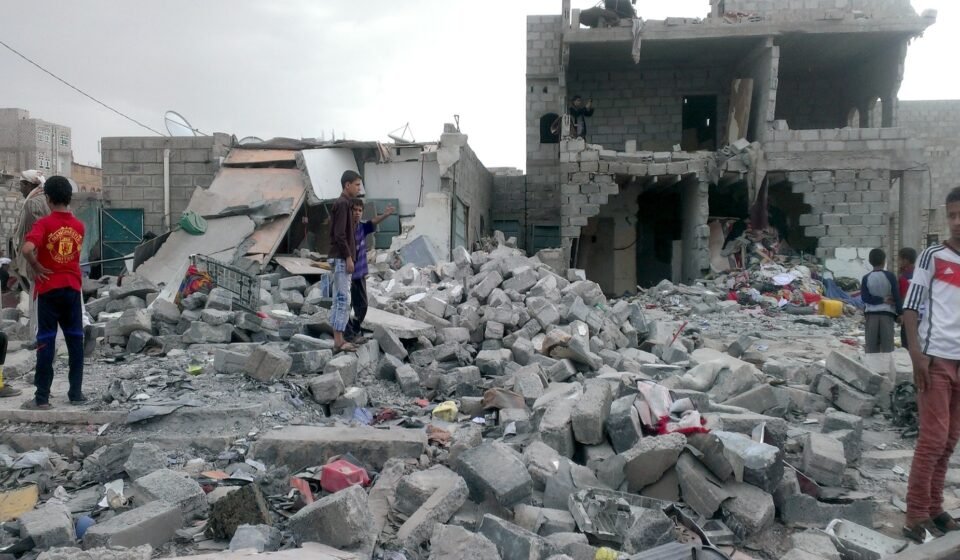

At least 22 people have been killed and around 30 others injured after airstrikes hit residential homes in a village near Yemen’s capital, Sanaa, on Saturday, according to a spokesman for the Houthi-run Health Ministry. Most of the reported victims were women and children, raising fresh concerns about the growing civilian toll as fighting intensifies across the country.
The strikes reportedly hit several homes in al-Shariya village, located near the Yemeni capital. Anees Alasbahi, a spokesman for the Houthi-run Health Ministry, provided the casualty figures and accused Saudi Arabia of carrying out the attacks.
However, the allegation could not be independently verified. Saudi authorities had not immediately issued a public response to the accusation, leaving responsibility for the airstrikes unconfirmed.
The incident comes amid a sharp deterioration in Yemen’s security situation, with renewed clashes between Houthi forces and the internationally recognised Yemeni government, which is backed by Saudi Arabia.
Homes reportedly hit in the airstrikes
According to the Houthi health official, Saturday’s attacks struck residential buildings in al-Shariya. The reported death toll stood at 22, while another 30 people were said to have suffered injuries.
Footage broadcast by Houthi-run Al-Masirah television showed emergency workers carrying injured people and children from ambulances to a local hospital. Images from the village showed damaged houses, debris and dust covering the area after the bombardment.
The scenes indicated the serious impact of the strikes on the local population. However, the available footage and statements did not provide an independently verified account of the exact number of homes destroyed or the circumstances surrounding each casualty.
Alasbahi also alleged that additional strikes targeted emergency responders who were attempting to assist victims. This claim had not been independently confirmed at the time of reporting.
The reported presence of women and children among the dead has added to concerns over civilian safety in areas affected by the renewed conflict.
Saudi Arabia accused, but responsibility remains unverified
The Houthi-run Health Ministry directly blamed Saudi Arabia for Saturday’s airstrikes. The accusation comes as Riyadh supports forces aligned with Yemen’s internationally recognised government in the conflict against the Houthis.
Saudi Arabia has previously led a military coalition supporting the Yemeni government against the Houthi movement. The two sides have remained opponents throughout the country’s prolonged conflict.
Nevertheless, the available information does not independently establish which aircraft carried out Saturday’s attack. Saudi Arabia had not immediately responded to the accusation, and no independent investigation had confirmed the circumstances of the bombing.
The distinction is important because both sides in Yemen’s conflict have repeatedly accused each other of attacks and civilian casualties. Claims made by parties involved in the fighting require independent verification before responsibility can be conclusively established.
Another deadly strike reported in southern Yemen
Saturday’s reported attack followed another deadly incident in southern Yemen a day earlier.
Houthi officials said an airstrike hit a market in southern Yemen on Friday, killing at least 30 people. The Houthis and the Saudi-backed Yemeni military blamed each other for that attack.
The competing accusations underline the increasingly dangerous situation for civilians as fighting spreads across different parts of the country.
The two incidents within a short period have raised fears that residential neighbourhoods, markets and other civilian locations could face greater risks if the conflict continues to expand.
Independent confirmation of the reported casualty figures and responsibility for the separate attacks remains limited.
Yemen’s civil war enters a more dangerous phase
Yemen has experienced years of conflict since Houthi fighters seized the capital, Sanaa, in 2014. The takeover triggered a military intervention led by Saudi Arabia in 2015 in support of the internationally recognised government.
A United Nations-brokered truce in 2022 significantly reduced large-scale fighting, although it did not produce a permanent political settlement. Negotiations between the opposing sides subsequently struggled to deliver a comprehensive agreement.
The security situation has deteriorated again during 2026. Fighting has intensified along several front lines, while both sides have increased military operations and exchanged accusations of attacks.
Recent developments have also raised concerns beyond Yemen’s borders. The Houthis have expanded their control along parts of the Red Sea coast and strategic areas near the Bab el-Mandeb Strait, an important maritime passage connecting the Red Sea with the Gulf of Aden.
The group’s military activities and attacks on Saudi interests have increased regional tensions. Saudi-backed forces have also intensified their operations against Houthi positions.
The renewed fighting has weakened hopes that the relative calm established after the 2022 truce could eventually lead to a lasting political settlement.
Humanitarian consequences could become more severe
The latest reported casualties come as Yemen continues to face a serious humanitarian crisis after more than a decade of war.
Millions of people have experienced displacement, food shortages and limited access to healthcare. The country’s infrastructure and public services have also suffered extensive damage during years of fighting.
An escalation in airstrikes and ground operations could make conditions worse, particularly for families living in areas close to active front lines.
Hospitals and emergency services may face additional pressure if casualties continue to rise. Damage to roads, markets and essential infrastructure could also disrupt the movement of food, fuel and medical supplies.
The renewed conflict has already raised concerns among international observers about the possibility of a broader military confrontation.
The United Nations has repeatedly called on the parties to reduce hostilities and return to negotiations. A lasting settlement would require cooperation on security arrangements, political representation and humanitarian access.
International concern over renewed escalation
The latest airstrikes highlight the growing difficulty of containing Yemen’s conflict. The fighting is no longer limited to isolated clashes, with military developments affecting strategic coastal areas, transport routes and locations near major population centres.
Any further escalation could also have implications for regional shipping and energy infrastructure because of Yemen’s position near the Bab el-Mandeb Strait and the wider Red Sea corridor.
For now, the immediate concern remains the civilian cost of the reported attacks near Sanaa. The Houthi-run Health Ministry has reported 22 deaths and 30 injuries, while the allegation against Saudi Arabia remains unverified.
With fighting continuing on multiple fronts, the latest incident has added urgency to calls for restraint and renewed diplomatic efforts to prevent further loss of civilian lives.