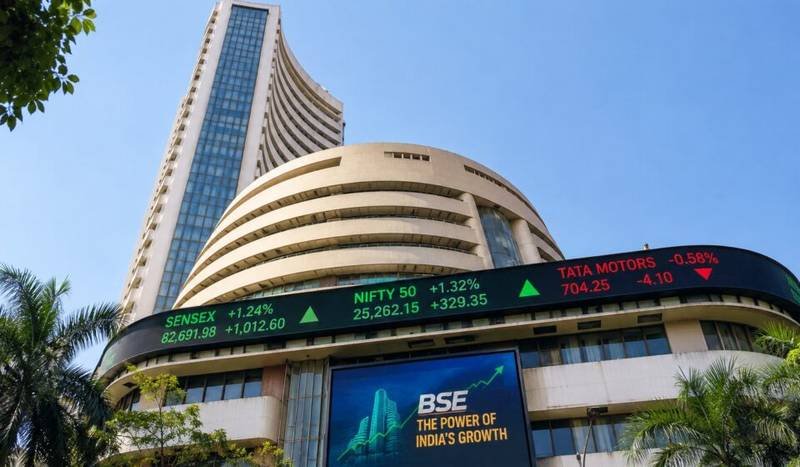

Indian equity markets are bracing for a cautious opening on Friday, November 6, after a sharp sell-off in US technology stocks triggered heavy losses across Asian markets. Early signals from GIFT Nifty point towards a weaker start for the Nifty 50 and BSE Sensex, raising the possibility of profit-booking after six consecutive sessions of gains on Dalal Street.
GIFT Nifty was trading around the 24,415–24,460 range in early morning deals, indicating a discount of roughly 160–185 points against the previous Nifty 50 close. The movement suggests that investors may begin the session on a defensive note as concerns over global technology valuations and artificial intelligence investments weigh on sentiment.
The domestic market, however, enters Friday’s session after a powerful rally. On Thursday, the Nifty 50 advanced approximately 576 points, or 2.40%, to close at 24,536.60. The Sensex climbed 2,008.61 points, or 2.60%, to settle at 79,310.01. Both benchmarks extended their winning streak to six sessions, supported by improving investor confidence, lower crude oil prices and strong foreign fund inflows.
Wall Street sell-off rattles global investors
The biggest concern for Indian investors is the sharp decline on Wall Street overnight. US equities witnessed widespread selling on Thursday, led by technology and semiconductor companies.
The Nasdaq Composite dropped 5.52% to close at 24,315.00, marking one of its steepest single-session declines in recent months. The S&P 500 fell 4.36% to 7,353.73, while the Dow Jones Industrial Average declined 3.44% to 51,523.06.
The sell-off reflected growing uncertainty around the future of artificial intelligence-related investments. Investors are questioning whether the enormous spending on data centres, advanced chips and AI infrastructure can continue at the pace previously expected.
Political developments in the United States have added another layer of uncertainty. Following the US midterm elections, market participants are assessing whether changes in the political balance could lead to tougher scrutiny or regulation of the technology industry.
The decline in major semiconductor stocks intensified the pressure. Nvidia, Advanced Micro Devices, Micron Technology and other chip-related companies recorded substantial losses, highlighting how quickly sentiment can change in sectors that had attracted significant investor enthusiasm.
Asian markets extend the technology sell-off
The weakness on Wall Street spread to Asian markets on Friday, with technology-heavy exchanges facing particularly strong pressure.
Japan’s Nikkei 225 declined sharply, falling more than 6% at one stage during early trading. South Korea’s Kospi also suffered heavy losses, dropping more than 7% and triggering a temporary trading halt under the exchange’s circuit-breaker mechanism.
Technology and semiconductor companies were among the biggest contributors to the regional decline. Shares of major chipmakers and electronics companies came under pressure as investors reassessed the outlook for global demand and AI-related capital expenditure.
Other Asian markets, including Hong Kong and mainland China, also traded lower. The broad decline indicates that the current weakness is not limited to a single market or company but reflects a wider reduction in appetite for risk.
For Indian equities, the international developments could influence sentiment during the opening hours. However, the extent of any domestic correction will also depend on local institutional activity, company-specific news and the strength of buying at lower levels.
Can domestic buying limit the damage?
Despite the negative global signals, India has some factors that could provide support to the market.
Foreign institutional investors have recently returned as significant buyers of Indian equities. On Thursday, foreign investors purchased shares worth approximately ₹14,974 crore, marking their fifth consecutive session of net buying. The reported inflow was among the strongest single-day purchases in recent years.
Domestic institutional investors, meanwhile, were net sellers, with sales of around ₹10,444 crore during the session. The difference between foreign and domestic flows will remain an important indicator for traders assessing the market’s direction.
Lower crude oil prices had also improved sentiment in the previous session. India imports a large share of its crude oil requirements, making energy prices an important factor for inflation, the current account and corporate costs.
However, crude prices rebounded in early Asian trading on Friday amid renewed concerns over supply disruptions in the West Asian region. Brent crude moved higher towards the $99-per-barrel level, although prices remained on track for a substantial weekly decline.
A sustained reduction in crude prices could support Indian equities, while another sharp increase may complicate the outlook.
Stocks likely to remain in focus
Investors may track companies reporting quarterly earnings and those facing company-specific developments.
Bharti Airtel could attract attention after its second-quarter profit missed market expectations, with higher network operating costs affecting performance despite subscriber additions and customer upgrades.
Titan, Life Insurance Corporation of India, ONGC and Britannia may also remain on investors’ radar following their latest earnings announcements. Their reported results and management commentary could influence trading in the respective sectors.
Apart from earnings, banking, information technology, energy and heavyweight index constituents may determine whether the benchmarks recover from an initial decline or remain under pressure.
What should investors watch during Friday’s session?
Market participants are likely to monitor three broad factors: the opening direction indicated by GIFT Nifty, the performance of Asian markets and the behaviour of institutional investors.
The Nifty 50’s previous close near 24,537 will be an important reference point. Traders may watch whether the index can regain lost ground after a weak opening or whether selling pressure increases as investors book profits following the recent rally.
The Sensex will also be closely watched after its substantial advance on Thursday. A decline following such a strong session would not necessarily indicate a change in the broader market trend, but it could signal that investors are becoming more cautious at elevated short-term levels.
Importantly, GIFT Nifty is an indicator of market expectations rather than a guarantee of the Indian market’s opening price. Actual trading may differ depending on overnight developments, pre-opening orders and domestic demand.
The key question for Dalal Street is whether strong foreign inflows and improving domestic sentiment can absorb the pressure coming from global markets. Friday’s session could provide an early indication of whether the six-day rally has enough strength to withstand international volatility.


