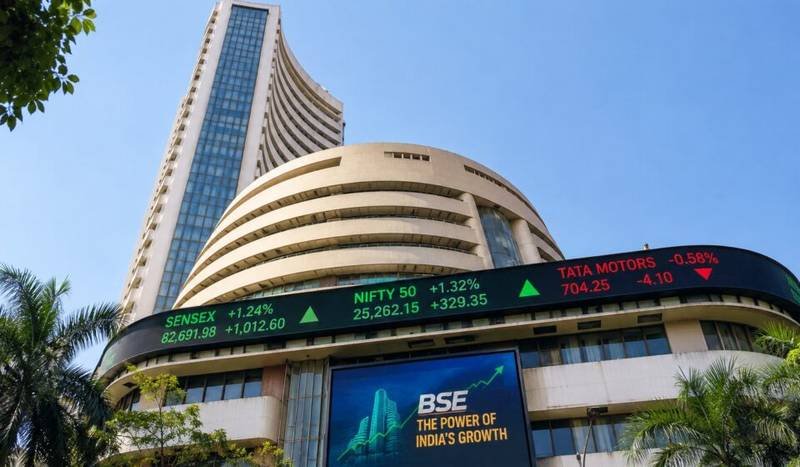
Indian Stock Market Today: Sensex, Nifty Outlook, GIFT Nifty Signals and Key Stocks to Watch on November 2

India’s stock market enters the first trading session of November with investors weighing the prospect of a recovery against persistent global and domestic risks. The Sensex and Nifty 50 ended October’s final session higher, supported by technology and pharmaceutical stocks. However, weakness across several broader-market segments suggests that the latest advance has not yet established a broad-based recovery.
Investors will closely monitor GIFT Nifty, crude oil prices, foreign institutional investor activity, the rupee, corporate earnings and international developments on Monday. These factors could influence the direction of benchmark indices as the new month begins.
Sensex and Nifty: Where the Market Stood
The BSE Sensex gained 308.49 points, or 0.42%, to close at 74,459.53 on Friday, October 30. The NSE Nifty 50 advanced 116.35 points, or 0.51%, to finish at 23,053.10, moving back above the psychologically important 23,000 mark.
The gains followed buying in information technology, pharmaceutical and healthcare stocks. However, the broader market remained under pressure, with mid-cap and small-cap indices declining during the session.
This difference between the benchmark indices and the broader market is important. A rally led by a limited number of heavyweight companies may lift the headline indices without indicating that investors are buying across the market.
For Monday, traders will look for evidence that buying is spreading to more sectors. Continued strength in large-cap stocks could support the benchmarks, while renewed selling in mid-cap and small-cap shares could limit the recovery.
GIFT Nifty Signals a Potentially Positive Opening
GIFT Nifty is an important indicator for traders preparing for the Indian market’s opening because its futures contract trades outside regular domestic equity-market hours.
A market snapshot available early on November 2 showed GIFT Nifty at approximately 23,242.5, up 182 points, or 0.79%. This suggested a positive opening bias at the time of the snapshot.
However, GIFT Nifty movements are not a guarantee of where the Nifty 50 will open or how the session will finish. Prices can change before the Indian market opens, and domestic trading may react differently once investors assess fresh orders, company news and global developments.
Investors should therefore compare the latest GIFT Nifty reading with the previous Nifty 50 close and monitor the domestic pre-open session before drawing conclusions about the day’s direction.
Nifty 50: Important Support and Resistance Levels
Market participants are watching whether the Nifty 50 can sustain its position above 23,000 and move towards higher technical resistance zones.
Based on levels discussed in recent market commentary, the following ranges may be useful for monitoring the session:
• Immediate support: Around 22,800.
• Near-term resistance: Around 23,175–23,250.
• Higher recovery zone: Around 23,300–23,500 if buying momentum strengthens.
These are indicative technical reference points, not guaranteed turning points or predictions of the closing level.
A sustained move above the resistance zone, supported by strong market breadth and trading volumes, could improve the near-term technical outlook. Conversely, a fall below 22,800 could weaken sentiment and increase the risk of renewed selling.
Traders should also watch whether the index holds above 23,000 during intraday volatility. A temporary move above a round-number level is less meaningful than a sustained move supported by broad participation.
Foreign and Domestic Investors: A Key Market Driver
Institutional investor flows remain an important factor in India’s equity market.
Available cash-market data for October 30 showed foreign institutional investors as net buyers of approximately ₹3,599 crore, while domestic institutional investors were net sellers of around ₹818 crore.
The figures indicate that foreign buying supported the market during that session. However, one day’s activity cannot establish a lasting change in institutional sentiment.
Foreign portfolio investors withdrew approximately ₹34,843 crore from Indian equities during October, extending their selling for a second consecutive month. Elevated crude oil prices, global interest-rate uncertainty and concerns about corporate earnings have contributed to investor caution.
If foreign investors continue returning to Indian shares, large-cap stocks could receive additional support. Sustained outflows, on the other hand, could limit gains even when domestic institutions or retail investors buy during market declines.
Investors should track daily and monthly institutional-flow data together rather than relying on a single session.
Crude Oil, the Rupee and Global Markets
Crude oil is one of the most important external variables for Indian equities because India imports a substantial share of its energy requirements.
Recent market reports have highlighted elevated international oil prices, with Brent crude trading above $117 a barrel in late-October commentary. Changes in oil prices may influence inflation, the country’s import bill, the rupee and the operating costs of energy-intensive businesses.
Higher crude prices can place pressure on oil-marketing companies if retail fuel prices do not adjust sufficiently to reflect rising costs. They can also affect aviation, paints, chemicals, logistics and other industries that depend heavily on fuel or petroleum-based inputs.
The currency market is another important factor. A weaker rupee can increase import costs and the burden of foreign-currency liabilities, although it may improve the translated overseas earnings of some exporters.
Investors will also monitor international bond yields, the US dollar, global technology shares and geopolitical developments. Any sudden change in these factors could influence overseas investment flows and the appetite for emerging-market equities.
IT Stocks Remain in Focus
Information technology shares were among the strongest performers during October’s final trading session.
The Nifty IT index rose sharply during the month as investors responded to corporate earnings, technology-sector performance and expectations surrounding artificial intelligence-related business opportunities.
IT companies may benefit from stronger technology spending and improved demand for digital services. However, concerns about the scale of AI investment, future returns and global technology valuations could still trigger volatility.
For Monday, investors will assess whether the recent strength continues and whether gains extend beyond a small number of large IT companies.
The sector’s performance will also matter for the Nifty 50 because major technology companies carry significant weight in the benchmark.
Pharma, Healthcare and Other Sectors
Pharmaceutical and healthcare stocks also supported the market on October 30. These sectors can sometimes attract investor interest when market participants seek businesses with different earnings drivers from highly cyclical industries.
Other sectors may react differently to the same economic conditions.
• Banking and financial services: Investors will monitor credit growth, asset quality, deposit costs and earnings outlooks.
• Automobiles: Sales trends, input costs and consumer demand will remain important.
• Oil and gas: Changes in crude prices, refining margins and fuel-marketing economics may influence individual stocks.
• Metals: Global industrial demand, commodity prices and overseas economic conditions could affect sentiment.
• Consumer goods: Input costs, pricing power and household spending will remain key considerations.
• Capital goods and infrastructure: Order books, execution and government or private-sector spending may influence company-specific performance.
Sector performance can diverge significantly from the broader indices. Investors should therefore examine individual company developments instead of assuming that every stock within a rising benchmark will also advance.
Stocks to Watch on November 2
Several companies are likely to remain on investors’ watchlists because of earnings, corporate developments or sector-specific news.
Reliance Industries and Jio Platforms: Investors will monitor reported business developments, earnings-related updates and the performance of the broader telecommunications and digital-services businesses.
Mahindra & Mahindra: The automobile company may attract attention as investors assess vehicle demand, margins and developments in the wider auto sector.
CDSL: Market participants may track developments affecting capital-market participation, demat accounts and trading activity.
ITC: Investors will watch demand trends, operating costs and company-specific developments across its businesses.
NTPC and NTPC Green Energy: Developments involving electricity demand, renewable-energy projects, investment plans and earnings could influence sentiment.
Indian Oil Corporation: Crude prices, refining margins, fuel-marketing economics and changes in the rupee are important variables for the company.
Hero MotoCorp: Investors will monitor two-wheeler demand, sales developments, input costs and the outlook for consumer spending.
Sun Pharmaceutical Industries: Company-specific news, earnings and the wider pharmaceutical sector’s performance may influence trading interest.
Bharat Electronics: Investors may follow order-related announcements, defence-sector developments and earnings expectations.
These companies are being highlighted for monitoring purposes, not as guaranteed gainers. A stock may decline even when its sector or the broader market rises, particularly if its valuation or company-specific news disappoints investors.
Corporate Earnings and Company Announcements
The September-quarter earnings season remains an important influence on Indian equities.
Investors will look beyond headline profit figures and examine revenue growth, margins, management commentary, order books and forward guidance. A company reporting higher profits may still face selling if the results fall short of market expectations.
Similarly, an apparently weak quarter may be received positively if the company’s outlook improves or its results are better than investors had anticipated.
Before trading, investors should check the latest exchange filings and company announcements for scheduled earnings releases, dividend decisions, major orders, acquisitions and other price-sensitive disclosures.
The list of stocks in focus can change quickly when new information becomes available.
Broader Market: Mid-Caps and Small-Caps Need Attention
The weakness in mid-cap and small-cap shares during the previous session suggests that investors remain selective.
Smaller companies can be more sensitive to changes in liquidity, valuations and risk appetite. Their share prices may also move more sharply than those of large, established companies.
A sustainable recovery would be more convincing if advances spread across large-, mid- and small-cap stocks, rather than remaining concentrated in a few benchmark heavyweights.
Investors should pay attention to market breadth, trading volumes, advances versus declines and the number of stocks reaching fresh highs or lows. These indicators can reveal whether a rally is broad-based or driven by a relatively narrow group of shares.
What Could Move the Market This Week?
Several developments could shape sentiment during the opening week of November:
1.Global political developments: International political and geopolitical news may affect oil prices, currencies and investor risk appetite.
2. Corporate earnings: Results and management guidance could drive sharp moves in individual stocks.
3. Foreign investor flows: Continued buying could support the benchmarks, while renewed selling could restrict gains.
4. Crude oil prices: Any further increase could add to inflation and corporate-cost concerns.
5. The rupee and global interest rates: Currency movements and overseas bond yields may influence foreign investment decisions.
6. Technical levels: The Nifty’s behaviour around 23,000, 22,800 and the 23,175–23,250 resistance zone may help traders assess momentum.
The market’s direction will depend on how these factors interact. A positive opening alone does not establish that a sustained rally has begun.
What Should Investors Keep in Mind?
Investors should avoid making decisions solely on the basis of GIFT Nifty or a single day’s market movement. Short-term price changes can reverse quickly, particularly when crude oil prices, international developments and institutional flows remain uncertain.
Long-term investors may focus on business fundamentals, valuations, debt levels, earnings quality and portfolio diversification. Short-term traders should establish risk limits and avoid taking positions without a clear strategy.
It is also important to distinguish between market commentary and confirmed developments. Technical support and resistance levels are analytical tools, not guarantees, and individual stocks can behave differently from the indices.
Market Outlook: A Recovery Attempt Faces Important Tests
Indian equities begin November with some positive momentum after the Sensex and Nifty 50 gained on October 30. Strength in IT and pharmaceutical shares, along with the early GIFT Nifty indication, provides a constructive starting point.
However, elevated crude prices, recent foreign-investor outflows and weakness in parts of the broader market remain significant risks. The immediate test will be whether the Nifty can hold above 23,000 and build enough buying momentum to challenge resistance near 23,175–23,250.
For investors, the key message is to follow the data as it develops. The opening trend, market breadth, institutional flows and company-specific announcements will help determine whether the early optimism translates into a broader recovery.
Disclaimer: This article is for informational and educational purposes only and does not constitute investment advice. Stock prices can rise or fall. Technical levels and stocks mentioned are for market monitoring, not buy or sell recommendations. Investors should assess their financial objectives and risk tolerance before making investment decisions.


