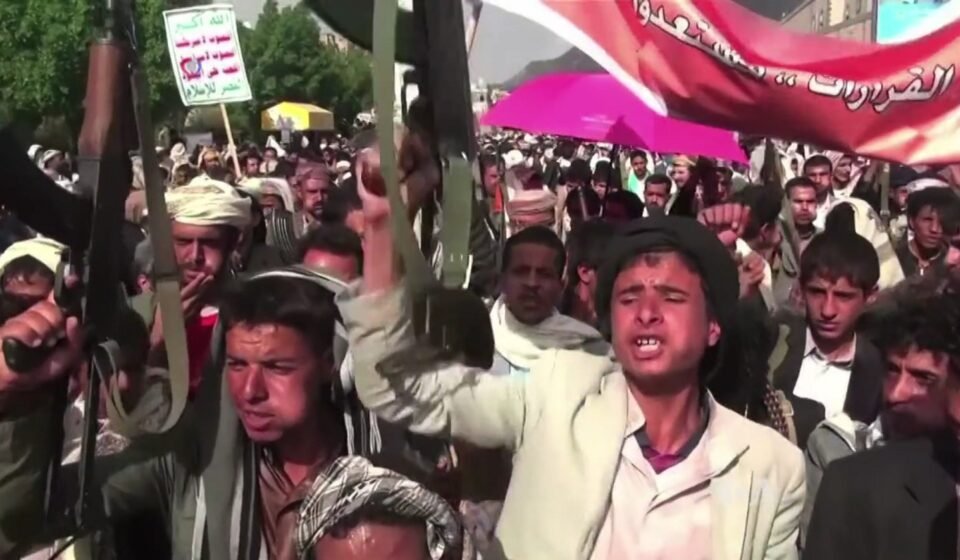

At least 20 people have reportedly been killed and 15 others injured after an attack struck a busy marketplace in southwestern Yemen, according to the Houthi-controlled health ministry. The incident took place in al-Waziyah district of Taiz province on Friday and is emerging as one of the deadliest reported attacks since fighting resumed between Houthi rebels and forces aligned with Yemen’s internationally recognised government.
The casualty figures were announced by Anees Alsabahi, a spokesperson for the Houthi health ministry, who said the death toll could increase as more information became available. He blamed the Saudi-led military coalition for carrying out airstrikes on the marketplace.
However, the responsibility for the attack remains disputed. Local authorities in Taiz acknowledged that a busy market had been attacked and that people were killed and injured, but they rejected the claim that aircraft carried out the strike. Instead, they blamed the Houthis for the incident.
The competing accounts have made it difficult to establish exactly what happened, who carried out the attack and how many people were ultimately affected.
Market in Al-Waziyah Hit Amid Renewed Fighting
The reported attack took place in al-Waziyah, an area in Taiz province in southwestern Yemen. The marketplace was reportedly busy when the incident occurred, raising concerns about the number of civilians who may have been caught in the violence.
According to the Houthi health ministry spokesperson, at least 20 people lost their lives and 15 others sustained injuries. The injured were reportedly taken for medical assistance, while the possibility of additional casualties remained open.
The Houthi side described the incident as an airstrike and accused the Saudi-led coalition of targeting the market. However, no independently verified account of the exact sequence of events or the weapons used was immediately available.
Local authorities confirmed that an attack had taken place at a crowded marketplace and acknowledged fatalities and injuries. They did not publish a separate casualty figure in their initial account.
The difference between the two accounts is significant because it concerns not only the number of victims but also the identity of those responsible and the nature of the attack.
Taiz Authorities Reject Airstrike Allegation
The local authorities in Taiz disputed the Houthi account, saying that no airstrikes had been carried out in the area. They instead blamed the Houthi movement for the incident.
The allegations have created two sharply different explanations of the same event. While the Houthi health ministry attributed the attack to the Saudi-led coalition, officials in Taiz rejected that version.
The available information does not establish which side was responsible. Independent verification of the claims was not immediately possible, and the precise circumstances surrounding the attack remain unclear.
The dispute also makes it important to distinguish between confirmation that an attack caused casualties and confirmation of who carried it out. Local authorities acknowledged deaths and injuries, but responsibility remains contested.
Why the Incident Matters for Yemen
Yemen has endured years of conflict involving the Houthi movement, the internationally recognised government and regional military actors. The Houthis seized the capital, Sanaa, in 2014, prompting a wider conflict. Saudi Arabia subsequently led a military coalition supporting the government against the rebel movement.
Taiz has remained an important area in Yemen’s conflict because of its strategic position and the presence of competing forces. The province has experienced repeated fighting and has faced serious humanitarian challenges during the country’s prolonged crisis.
The latest marketplace incident comes at a time when fighting between Houthi rebels and Saudi-backed government forces has reportedly intensified again. An attack in a crowded civilian location could further increase tensions and make efforts to reduce violence more difficult.
Markets are essential public spaces in Yemen, where many families depend on daily trade to obtain food and other basic necessities. Violence in such locations can affect not only those directly injured or killed but also traders, transport workers, nearby residents and families who rely on the marketplace.
Civilian Protection Raises Fresh Concerns
The reported deaths have renewed concerns about the safety of civilians in areas affected by Yemen’s conflict. Crowded markets, residential neighbourhoods and other public spaces can become especially dangerous when fighting reaches populated areas.
International humanitarian law requires parties to an armed conflict to distinguish between civilians and combatants and to take precautions to reduce civilian harm. Any allegation of an attack on a civilian marketplace therefore requires careful and impartial investigation.
At this stage, the available information does not establish whether the marketplace was deliberately targeted, whether military objectives were present nearby or what weapons were used. Those questions will need to be answered through independent investigation and reliable evidence.
The reported number of casualties could also change as local medical facilities and authorities assess the situation. The Houthi spokesperson has already indicated that the death toll may rise, while local officials have not yet released a detailed breakdown.
Investigation and Independent Verification Needed
The immediate priority is to provide medical assistance to those injured and establish the identities and circumstances of the people killed. A transparent investigation would also be necessary to determine the sequence of events and identify the party responsible.
The conflicting statements from the Houthi side and Taiz authorities underline the difficulty of verifying information in a conflict zone. Claims made by parties involved in the fighting should be assessed against independent evidence before responsibility is assigned.
For now, at least 20 deaths and 15 injuries have been reported by the Houthi health ministry, while local authorities have confirmed that an attack on the market caused casualties without endorsing the airstrike allegation.
The incident is another reminder of the devastating human cost of Yemen’s prolonged conflict. As rival sides exchange accusations, civilians in affected communities remain exposed to the consequences of renewed violence. Establishing the facts and protecting people in public spaces will be essential as the situation develops.