Abu Dhabi Talks End Without Major Breakthrough as Russia and Ukraine Remain Divided on Peace Terms

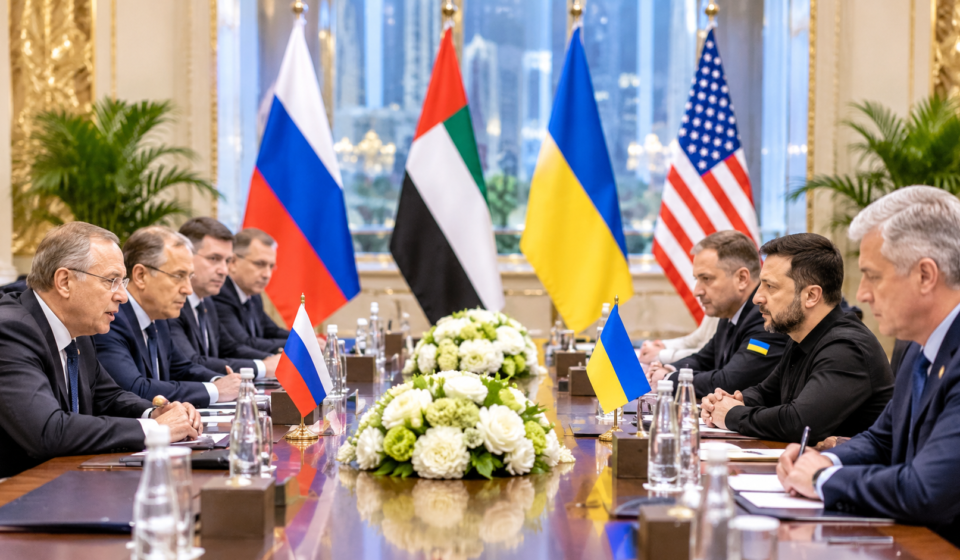
The second day of US-mediated negotiations between Russia and Ukraine ended in Abu Dhabi on Wednesday without a major breakthrough, leaving the possibility of a ceasefire and a wider peace settlement uncertain. The discussions brought the two sides together with American mediators for another round of diplomatic engagement, but their fundamental disagreements over territory, security and the future of Ukraine remained unresolved.
The second day began with a trilateral format involving representatives from Russia, Ukraine and the United States. Ukraine’s chief negotiator, Rustem Umerov, had announced that the delegations would first meet together before Ukrainian officials held separate discussions with European partners.
The meetings were part of Washington’s renewed effort to find a diplomatic path towards ending the war. US President Donald Trump’s envoys Steve Witkoff and Jared Kushner were involved in the mediation, while the Russian delegation was led by Vladimir Medinsky and Ukraine’s team was headed by Umerov.
A source from the Russian delegation later indicated that the two-day round of negotiations had concluded. However, no comprehensive peace agreement or publicly confirmed ceasefire arrangement emerged from the discussions.
Second-day agenda focused on de-escalation
The agenda for Wednesday’s negotiations included possible steps to reduce military tensions, energy security and the security situation in the Black Sea.
These issues are important because the war has increasingly affected infrastructure and essential economic activities beyond the immediate battlefield. Attacks on electricity facilities and energy installations have disrupted civilian life in Ukraine, while maritime security remains important for trade, shipping and the movement of agricultural goods through the Black Sea.
Ukraine has been seeking arrangements that could reduce attacks on critical infrastructure and create conditions for a broader ceasefire. Discussions about the Black Sea are also significant because the region is an important route for international trade and a strategic area for both countries.
However, the completion of discussions does not mean that the sides reached an agreement on these subjects. No detailed public announcement confirmed a final arrangement covering energy facilities, maritime security or a wider reduction in military operations.
Prisoner exchange remains an important humanitarian issue
A possible large-scale prisoner exchange was among the issues surrounding the Abu Dhabi negotiations. Ukrainian President Volodymyr Zelenskyy had said that the two sides had discussed possible exchanges involving 1,000 prisoners from each side, with another option of 1,500 for 1,500.
The proposal could become one of the most important humanitarian outcomes of the diplomatic process if both governments agree on the numbers, names and practical arrangements.
Prisoner exchanges are particularly important for families who have spent months or years waiting for information about relatives captured during the conflict. A successful arrangement could also demonstrate that Moscow and Kyiv remain capable of reaching limited agreements even when wider political negotiations are difficult.
However, the proposed numbers should not be treated as a completed exchange. A final date, confirmed list of prisoners and publicly announced implementation plan were not established in the available information following the second day.
Territorial dispute continues to block progress
The biggest obstacle remains the question of territory.
Russia controls a substantial part of Ukrainian territory and continues to demand that Kyiv accept Moscow’s claims. One of the central issues is the Donbas region in eastern Ukraine, where Russia has insisted that Ukraine surrender the remaining territory it controls.
Ukraine has rejected demands to give up land. President Zelenskyy has maintained that decisions involving the country’s territory and sovereignty cannot simply be made by negotiators without political leadership.
The disagreement is not merely about drawing a new border. It involves the future of communities, access to important infrastructure, control of strategic locations and the security of millions of people.
For Kyiv, accepting territorial concessions under military pressure could create the risk of further Russian demands in the future. Moscow, meanwhile, has continued to make territorial control a central condition in its approach to a settlement.
These opposing positions have made it difficult for the negotiators to move from general discussions towards a detailed peace agreement.
Ukraine’s security guarantees and NATO question
Another major issue is how Ukraine would be protected if a ceasefire or peace agreement is reached.
Kyiv wants long-term security guarantees that could prevent another Russian military operation. Ukrainian officials have argued that a peace agreement would have little value if it did not include practical measures to discourage renewed aggression.
Russia has its own security demands. Moscow has repeatedly opposed Ukraine joining NATO and has called for Ukraine to adopt a neutral status.
These positions remain difficult to reconcile. Ukraine views its freedom to choose international partnerships as part of its sovereignty, while Russia regards NATO’s possible expansion towards its borders as a major security concern.
The negotiations have therefore involved more than the immediate question of stopping the fighting. They also concern the future security structure of Europe and the relationship between Russia, Ukraine and Western countries.
Europe’s role remains complicated
European governments have been seeking a greater role in negotiations that could determine the future of the continent’s security.
Representatives from European countries, the European Union and NATO were in Abu Dhabi and held consultations with Ukrainian and American officials. Their involvement is important because any lasting settlement could have direct consequences for European defence, borders and regional stability.
Russia, however, has opposed European participation in the direct trilateral negotiations. The Kremlin indicated that its delegation had not held separate discussions with European representatives in Abu Dhabi and that no such contacts were planned during this round.
European officials have argued that Ukraine’s sovereignty and territorial integrity must remain central to any settlement. They have also stressed the importance of credible security guarantees and a ceasefire before broader discussions about Europe’s future security arrangements.
This difference over Europe’s role adds another challenge to the American diplomatic effort.
Fighting continued during negotiations
The diplomatic meetings took place while military activity continued. Ukrainian officials reported Russian attacks on electricity substations and an energy facility, while Russia also reported Ukrainian drone strikes on its territory.
These developments underline the difficulty of negotiating peace while military operations continue. Attacks on infrastructure can increase pressure on governments and civilians, but they can also make compromise politically harder.
The negotiations have not yet produced a publicly confirmed arrangement that would stop such attacks.
What comes after Abu Dhabi?
The end of the second day does not close the door on diplomacy. The discussions have kept communication open between Moscow and Kyiv and provided Washington with another opportunity to assess whether the two sides can move towards limited agreements.
A prisoner exchange, arrangements for energy infrastructure or measures to improve Black Sea security could offer possible areas for further progress. However, these steps would not automatically resolve the territorial dispute or the disagreement over Ukraine’s future security arrangements.
For now, the main outcome of the November 11 meeting is the continuation of diplomatic contact without a major public breakthrough. The next stage will depend on whether the governments are prepared to turn discussions into specific commitments.
The Abu Dhabi negotiations have shown that the parties are still willing to meet, but the distance between their demands remains considerable. A lasting peace will require more than another round of talks: it will require decisions on territory, security and guarantees that both sides are prepared to accept.